


I. The Man with the Vision
In the early 1930s, Key West, Florida, was a humid, isolated island at the southernmost tip of the United States. It was a place where strange stories often drifted in with the tide, but none would be as bizarre or unsettling as the story of Carl Tanzler.
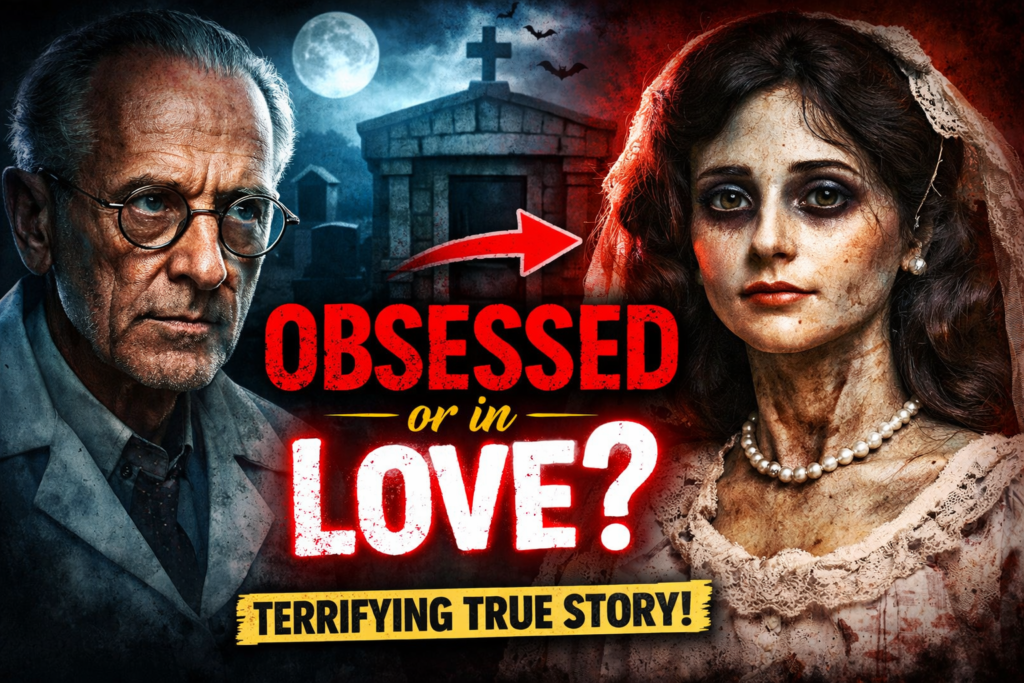
Tanzler was a German immigrant working as an X-ray technician at the U.S. Marine Hospital. He was a man of eccentric habits and grand delusions. For years, he claimed that the ghost of his ancestor had visited him in visions, revealing the face of his true love—a dark-haired, exotic beauty. In 1930, a young Cuban-American woman named Elena de Hoyos walked into his hospital for an examination. Tanzler froze. She was the exact woman from his dreams.
Unfortunately, the romance was doomed from the start. Elena was diagnosed with tuberculosis, a fatal disease at the time. Tanzler, obsessed and desperate, used his position at the hospital to treat her with homemade elixirs and stolen medical equipment, convinced he could save her. Despite his erratic efforts, Elena passed away in October 1931 at the young age of 22.
II. The Stone Fortress
Tanzler was devastated, but his obsession did not die with Elena. With the permission of her grieving family, he paid for her funeral and commissioned an expensive, above-ground stone mausoleum in the Key West Cemetery. It was an unusual gesture for a man who was not her husband, but the family accepted it as an act of kindness.
For two years, Tanzler visited the grave every single night. He was the only person with a key to the tomb. The townspeople viewed him as a tragic, romantic figure—a heartbroken man mourning his lost love. They watched him walk to the cemetery each evening, unaware of the disturbing reality. Inside the stone walls, Tanzler was not just praying; he was attempting to communicate with Elena, believing she was calling out to him, begging to be taken home.
III. The Midnight Abduction
In 1933, the nightly visits suddenly stopped. Tanzler told people that the spirit of Elena had instructed him to take her away from the “cold” grave. Under the cover of darkness, he crept into the cemetery, removed Elena’s body from her coffin, and loaded it into a child’s red toy wagon. He dragged the heavy cart through the silent streets of Key West to his secluded home.
Once inside, Tanzler realized that two years in the humid Florida climate had taken a toll on the body. It was in a state of advanced decay. Rather than accepting reality, Tanzler began a macabre project of “restoration.” He was determined to preserve Elena’s beauty, no matter the cost.
IV. The Wax Doll
Over the next seven years, Tanzler transformed the remains into something resembling a large doll. As her skin deteriorated, he replaced it with silk cloth soaked in wax and plaster. When her hair fell out, he fashioned a wig from strands of hair he had collected from her mother years earlier. To maintain the human shape, he stuffed the body with rags and used wire coat hangers to stiffen the limbs. He even replaced her eyes with glass orbs.
To mask the overwhelming odor of decomposition, Tanzler used gallons of perfume and formaldehyde. He lived with this “doll” as if she were his living wife. He dressed her in fine clothes, sat her at the dinner table, played music for her, and slept next to her every night. In his delusion, the line between life and death had completely vanished.
V. The Unraveling
The secret could not be kept forever. By 1940, rumors began to circulate in the neighborhood. People whispered that they had seen Tanzler dancing with a giant doll through his window. Elena’s sister, Florinda, became suspicious. She went to Tanzler’s home to confront him and, looking through a window, saw a figure that looked terrifyingly like her deceased sister.
She contacted the authorities immediately. When police and medical examiners entered the home, they found the figure in Tanzler’s bed. They initially thought it was a crude effigy. However, an autopsy revealed the horrifying truth: inside the wax and silk shell were the skeletal remains of Elena de Hoyos.
Tanzler was arrested, but the case ended in a bizarre twist. The statute of limitations for grave robbing had expired, so he was released. Even stranger was the public reaction. Many people in Key West did not view him as a monster, but as an “eccentric romantic” who had loved a woman beyond death. The body of Elena was put on public display at a funeral home, where over 6,000 people paid to view the “doll” before she was finally buried in an unmarked grave, safe from Tanzler’s obsession.
Part 2: 🧠 The Psychology of Human Behavior
Concept: Delusional Disorder (Erotomania)
Carl Tanzler’s behavior can be explained through the lens of Delusional Disorder, specifically a subtype known as Erotomania mixed with Grandiosity.
- Delusional Disorder is a mental health condition where a person cannot tell what is real from what is imagined. Unlike schizophrenia, people with this disorder often function normally in daily life (Tanzler held a job and paid bills), but they hold one specific, unshakable false belief.
- Erotomania is the specific delusion that another person is deeply in love with them. Tanzler believed Elena was his “true bride” and that she loved him back, even though in reality, she was just his patient and likely had no romantic interest in him.
- The Connection to the Story: This disorder explains why Tanzler didn’t see a corpse. His brain altered his reality to protect his delusion. When he looked at the decaying body, his mind likely “corrected” the image, allowing him to see the beautiful woman he wanted to see. He wasn’t lying when he said she spoke to him; his brain was hallucinating her voice to feed the delusion that they were still in a relationship.
Part 3: 📚 Key Vocabulary
- Eccentric(Adjective)
- Definition: (Of a person or their behavior) unconventional and slightly strange.
- Synonym: Peculiar / Odd
- Mausoleum(Noun)
- Definition: A building, usually large and stately, housing a tomb or tombs.
- Synonym: Crypt / Vault
- Macabre(Adjective)
- Definition: Disturbing and horrifying because of involvement with or depiction of death and injury.
- Synonym: Gruesome / Ghastly
- Deteriorate(Verb)
- Definition: To become progressively worse; to break down or decay.
- Synonym: Degenerate / Decay
- Effigy(Noun)
- Definition: A sculpture or model of a person (often used to describe a crude or rough representation).
- Synonym: Likeness / Figure
- Restoration(Noun)
- Definition: The action of returning something to a former owner, place, or condition.
- Synonym: Repair / Reconstruction
- Unravel(Verb)
- Definition: To investigate and solve or explain (something complicated or puzzling); also, to come apart or fail.
- Synonym: Resolve / Collapse (depending on context)
Part 4: 📝 Grammar Spotlight
The Structure: The Passive Voice (Object + to be + Past Participle)
Quote from Text:
“The body was stuffed with rags and the limbs were stiffened with wire coat hangers.”
Why is it used here? In English, we typically use the Active Voice (Subject + Verb + Object) to focus on the person doing the action (e.g., Tanzler stuffed the body).
However, in this text, the author uses the Passive Voice to shift the focus away from Tanzler and onto the object (the body).
- Objectification: It emphasizes that Elena’s body was being treated like a thing—a doll or a project—rather than a person.
- Process Focus: It highlights the mechanical, surgical nature of what was being done to the body. The specific actions (stuffing, stiffening) are more important to the horror of the scene than simply stating “Tanzler did this.”
