

Part 1: Reading Comprehension
The Cartographer’s Final Riddle: A Map to Nowhere
The Vanishing of Elias Vance The disappearance of Elias Vance remains one of the most perplexing mysteries in the annals of modern exploration. Vance was not a typical explorer; he did not climb mountains or sail turbulent oceans. He was a cartographer—a mapmaker—but one of such singular genius that his charts were said to be more accurate than reality itself. He lived in a secluded, dusty workshop on the edge of London, a place filled with the scent of old parchment, drying ink, and the ticking of complex clockwork instruments.
On the morning of November 14th, the silence of the workshop was broken by the arrival of the local police. They found the door unlocked and a pot of tea still warm on the stove. However, the room was empty. There were no signs of a struggle, no forced entry, and no footprints leading away from the house in the fresh mud outside. Elias Vance had simply ceased to exist. The only clue left behind was resting on his drafting table: a large, unfinished map.
The Master and the Apprentice To understand the map, investigators turned to the only person who knew Elias intimately: his apprentice, Thomas Thorne. Thomas was a young, ambitious man who looked at his mentor with a mixture of deep admiration and bitter envy. During the interrogation, Thomas revealed that in the months leading up to his disappearance, Elias had descended into a strange eccentricity.
“He was obsessed,” Thomas told the detectives, his voice trembling. “He didn’t just want to map geography anymore. He wanted to map feeling. He wanted to capture the sensation of the wind, the coldness of the stone, the smell of the rain. He called it ‘The Absolute Chart.'”
Thomas described how Elias would work for days without sleeping, muttering to himself in languages that Thomas couldn’t recognize. The master had become convinced that a perfect map shouldn’t just represent a place—it should be the place.
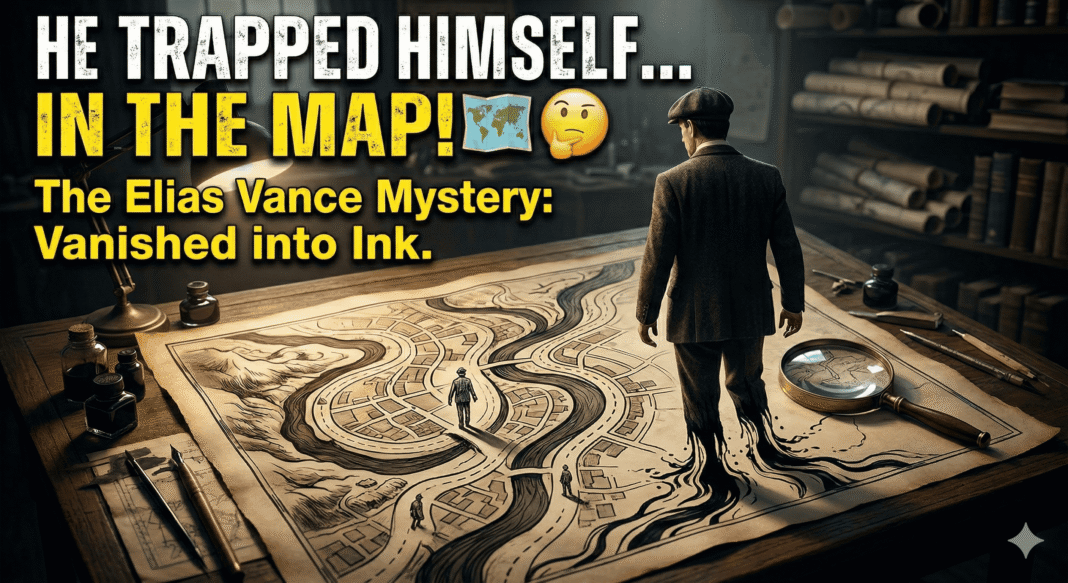
Impossible Geometry When forensic experts examined the map found on the desk, they were baffled. It was a beautiful document, drawn with exquisite precision, but it depicted a landscape that did not exist on Earth.
The geography was impossible. Rivers flowed uphill. Streets looped back into themselves in ways that defied physics. The architecture drawn in the margins resembled non-Euclidean geometry—shapes that looked normal at a glance but became maddeningly wrong when examined closely. It was a labyrinth of ink that hurt the eyes to look at for too long.
Furthermore, the symbols used on the legend belonged to no known civilization. Linguists from Oxford were brought in, but they could decipher nothing. The map was a masterwork of nonsense.
The Final Confession The climax of the investigation came when Thomas Thorne was brought in for a second, more intense interview. The police suspected foul play. They believed the apprentice, jealous of the master’s genius, had murdered Elias and hidden the body.
Cornered in the interrogation room, a distressed Thomas finally broke. “You are looking for a body,” he whispered, “but you won’t find one.”
“Where did you hide him?” the detective demanded.
Thomas looked up, his eyes wide with a terrifying realization. “I didn’t hide him. I watched him finish it. He drew the final line, he signed his name… and then he stood up.” Thomas paused, tears streaming down his face. “He didn’t leave the room, Detective. He walked into his work. He stepped onto the paper, and the ink… it swallowed him. He is in the map.”
A Living Document The case was never officially closed. Thomas Thorne was released due to a lack of physical evidence, though he spent the rest of his life in a sanatorium. The map itself sits in an evidence locker in London, filed under “Unsolved Cases.”
However, there is a rumor among the archivists who work there. They say that if you look at the map under a magnifying glass, the lines are never in the same place twice. They shift. They rearrange. And sometimes, if the room is very quiet, you can see a tiny, ink-drawn figure walking along the paper roads, wandering forever in a world of his own making.
Part 2: Study Guide
🧠 The Psychology of Human Behavior Concept: The “Tetris Effect” (Cognitive Immersion) While Thomas’s claim that Elias walked into the map is physically impossible, psychology offers a fascinating explanation for what happened to the men’s minds. This is an extreme example of the Tetris Effect (also known as cognitive immersion). This phenomenon occurs when people devote so much time and attention to an activity (like playing the video game Tetris, or in this case, drawing maps) that it begins to pattern their thoughts, mental images, and dreams. Elias likely suffered from a break in reality due to extreme isolation and obsession. For Thomas, the trauma of losing his mentor caused him to hallucinate, his brain trying to make sense of the disappearance by merging the man with his obsession.
📚 Key Vocabulary
- Secluded (adj.): Hidden from view; private and not used by many people. (Synonym: Isolated)
- Perplexing (adj.): Completely baffling; very puzzling. (Synonym: Confusing)
- Eccentricity (noun): Strange or unconventional behavior. (Synonym: Oddity)
- Decipher (verb): To convert (a text written in code, or a difficult signal) into normal language. (Synonym: Decode)
- Labyrinth (noun): A complicated irregular network of passages or paths in which it is difficult to find one’s way. (Synonym: Maze)
- Defy (verb): To appear to be challenging to do or prove impossible. (Synonym: Resist)
📝 Grammar Spotlight
- Structure: The Past Perfect Continuous (had been + verb-ing)
- Quote: “Thomas described how Elias had been working for days without sleeping.”
- Why use it? We use the Past Perfect Continuous to emphasize the duration of an activity that happened before another action in the past. In this story, the “main past” is the police investigation. We use the Past Perfect Continuous to show that Elias’s obsession was a long process that happened before the police arrived. It helps build the backstory and shows that his madness grew slowly over time.
Part 3: Student Exercises
Exercise 1: Reading Comprehension
Answer the following questions based on the text.
- What was unusual about the physical scene the police found in Elias Vance’s workshop?
- How did Elias’s goal for his mapmaking change in the months before he vanished?
- Give two examples from the text of why the map’s geography was considered “impossible.”
- Why did the police initially suspect Thomas Thorne of foul play?
- How does the psychological concept of the “Tetris Effect” explain Thomas Thorne’s final confession?
Exercise 2: Vocabulary in Context
Fill in the blanks using the Key Vocabulary words from the study guide. You may need to change the tense or form slightly.
- The detective found the clues completely ________, making it the hardest case of his career.
- After years of isolation, the brilliant scientist’s ________ became more apparent to his colleagues.
- The ancient manuscript was written in a dead language that took experts decades to ________.
- The cabin was hidden deep in a ________ forest, far away from the noise of the city.
- The escaping suspect ran into a ________ of narrow, twisting alleyways and disappeared.
- The architect designed a futuristic building that seemed to ________ the laws of gravity.
Exercise 3: Grammar Application (Past Perfect Continuous)
Complete the sentences by putting the verb in brackets into the correct Past Perfect Continuous form (had been + verb-ing).
- Before he finally disappeared, Elias ______________ (work) on ‘The Absolute Chart’ for weeks without adequate sleep.
- The police discovered that the tea was warm, meaning someone ______________ (drink) it shortly before they arrived.
- Thomas ______________ (study) under his mentor for three years when the strange behavior first started.
- The investigators realized that Elias ______________ (mutter) in unrecognizable languages long before he vanished.
- The local police ______________ (search) the muddy grounds for hours before they finally accepted there were no footprints.
Part 4: Answer Key
Exercise 1: Reading Comprehension
- The door was unlocked, tea was still warm on the stove, but there were no footprints in the mud outside, no signs of a struggle, and no forced entry.
- He no longer wanted to just map geography; he wanted to map feelings and sensations (like wind, cold, and smell), calling it “The Absolute Chart.”
- Rivers flowed uphill, and streets looped back into themselves in ways that defied physics (non-Euclidean geometry).
- They believed Thomas was jealous of his master’s genius and had murdered him to steal his work or out of bitter envy.
- The Tetris Effect suggests that Thomas was so cognitively immersed in the mapmaking world, combined with the trauma of losing his mentor, that he hallucinated Elias stepping into the map to make sense of the sudden disappearance.
Exercise 2: Vocabulary in Context
- perplexing
- eccentricity
- decipher
- secluded
- labyrinth
- defy
Exercise 3: Grammar Application
- had been working
- had been drinking
- had been studying
- had been muttering
- had been searching