

Level: Intermediate / Upper-Intermediate
By: Dr. Henry
1. The Case of the “Focus Shift”
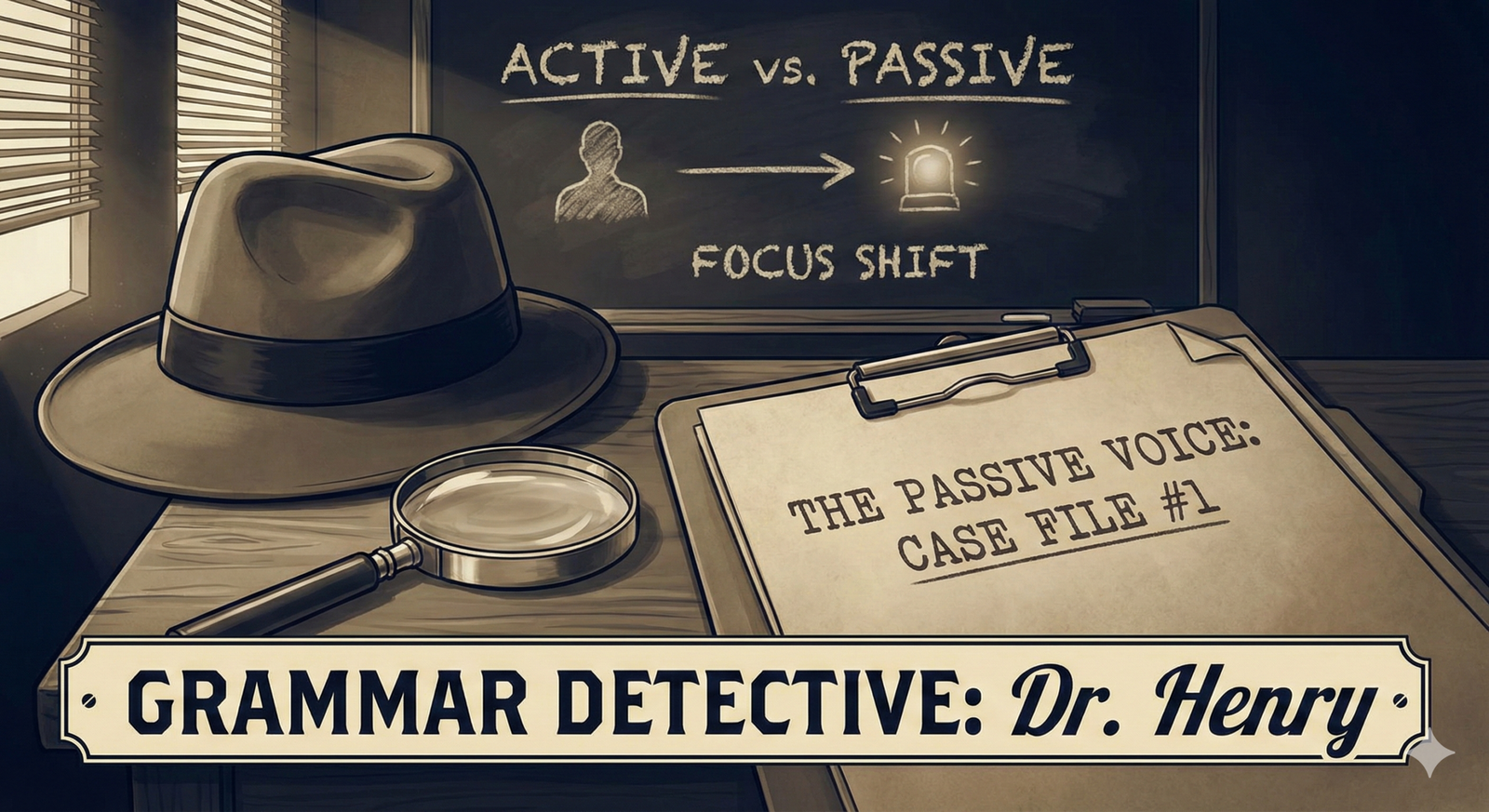
In English, the normal way to speak is the Active Voice. We focus on the person doing the action (The Doer).
- Active: Jack won the prize. (Focus is on Jack).
But sometimes, the “Doer” isn’t the most important part of the story. Maybe the result is more important. To shift the spotlight, we use the Passive Voice.
- Passive: The prize was won by Jack. (Focus is on The Prize).
The Golden Rule:
To make a passive sentence, you need the verb TO BE + PAST PARTICIPLE (V3).
- Present: is done / are done
- Past: was done / were done
- Present Perfect: has been done
2. The Suspects: Agent vs. Instrument
When we use the passive, we often remove the doer completely. But if we want to mention them, we must use the correct preposition.
A) The Agent (Use “BY”)
The “Agent” is the person or living thing that started the action.
- Correct: The picture was painted by Picasso.
- Correct: My purse was found by a cleaner.
B) The Instrument (Use “WITH”)
The “Instrument” is the object or tool used to do the action. The tool didn’t decide to do it; it was used.
- Correct: The window was broken with a hammer. (The hammer didn’t break it alone; someone used it).
- Correct: The cake was cut with a sharp knife.
⚡ Detective Tip: If you can ask “Who did it?”, use BY. If you can ask “What did they use?”, use WITH.
3. The “Double Agents” (Verbs with Two Objects)
Some verbs are generous. They give things to people. These verbs (like give, send, lend, offer, promise, sell, tell) have two passive forms.
Active Sentence: “Someone gave me a note.”
We can start the passive sentence with the person (Me) or the thing (A note).
Method 1 (Person Focus – More Common):
- I was given a note.
- This sounds natural and personal.
Method 2 (Thing Focus):
- A note was given to me.
- Note: If you start with the thing, you must add “to” before the person.
4. The Alibi: Verbs That Can NEVER Be Passive
Be careful! You cannot arrest every verb. Some verbs are “Intransitive”—they have no object to move to the front.
- Happen / Occur / Fall / Die / Sleep
- Wrong: The accident was happened. ❌
- Correct: The accident happened. ✅
Also, State Verbs (verbs that describe a situation, not an action) resist the passive voice.
- Have / Fit / Suit / Resemble / Lack
- Wrong: A nice car is had by him. ❌
- Correct: He has a nice car. ✅
- Wrong: His father is resembled by him. ❌
- Correct: He resembles his father. ✅
5. The Motive: Why Hide the Agent?
Why do we delete the “Doer”? Usually for one of these four reasons:
- Unknown Agent: We don’t know who did it.
- My wallet has been stolen. (By who? I don’t know!)
- Obvious Agent: It is clear who did it, so we don’t need to say it.
- The thief was arrested. (By the police—obviously!)
- Unimportant Agent: We care about the process, not the worker.
- The bridge is being repaired. (It doesn’t matter which worker is holding the shovel).
- Generalised Agent: It refers to “people in general.”
- English is spoken here. (By people).
🕵️♂️ Detective Training: Practice Exercise
Task: Rewrite the following active sentences into the Passive Voice. Decide if you need to keep the agent.
- Someone has taken my phone!
- People speak Spanish in Mexico.
- The police caught the bank robbers yesterday.
- Someone used a brick to smash the window.
- They sent me a strange email this morning. (Start with “I”)
- They sent me a strange email this morning. (Start with “A strange email”)
- People consider him a genius.
- The cleaner cleans the office every night.
🔑 Answer Key (Confidential)
- My phone has been taken! (Agent omitted – Unknown)
- Spanish is spoken in Mexico. (Agent omitted – Generalised)
- The bank robbers were caught yesterday. (Agent omitted – Obvious)
- The window was smashed with a brick. (Use “with” for instrument)
- I was sent a strange email this morning. (Person focus)
- A strange email was sent to me this morning. (Thing focus + “to”)
- He is considered a genius. (Complement structure)
- The office is cleaned every night. (Agent omitted – Unimportant/Job role)


