


I. The Silent Farmhouse
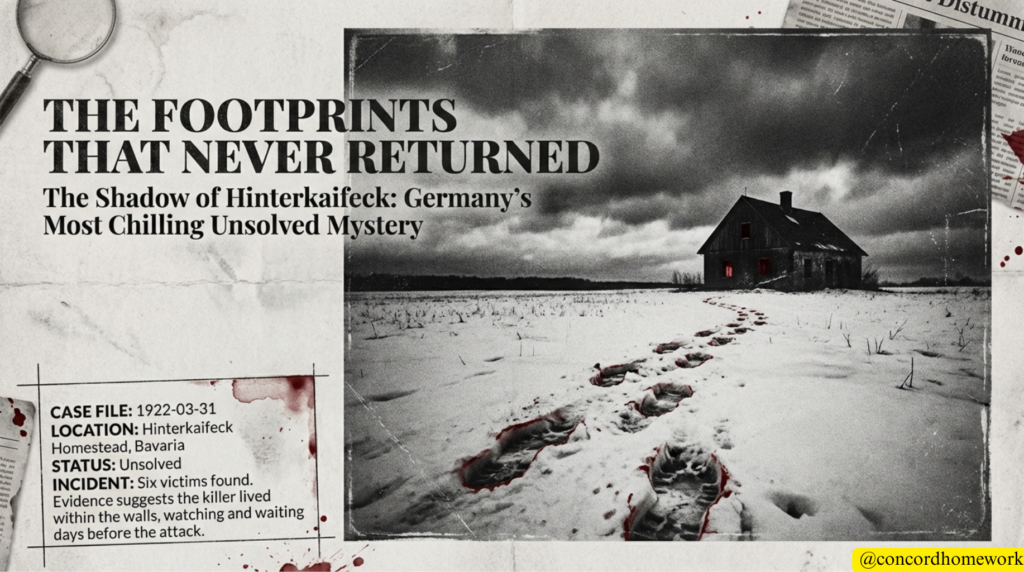
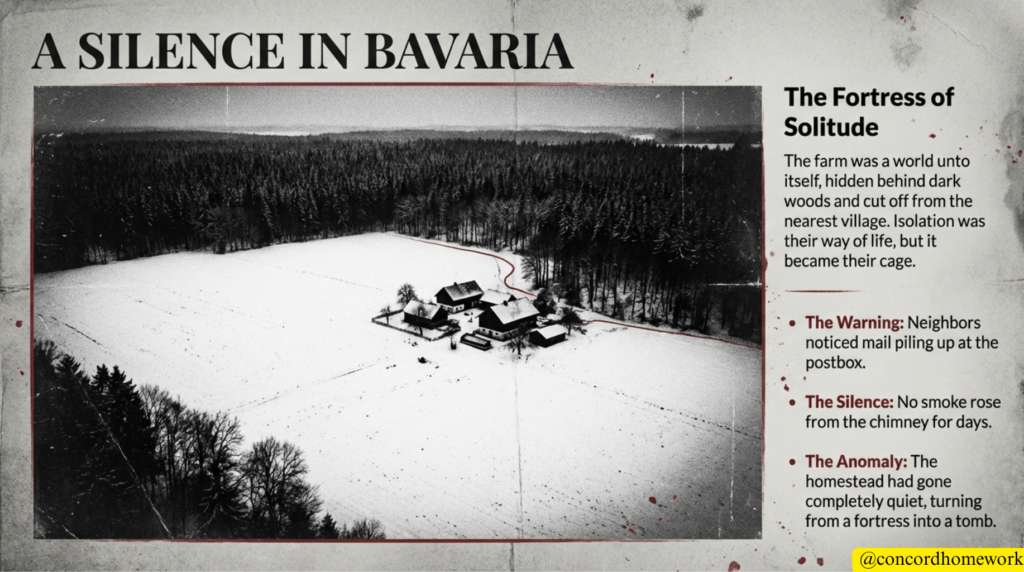
In the deep winter of 1922, a heavy silence descended upon the small Bavarian hamlet of Kaifeck. Just outside the village stood a solitary farmstead known as Hinterkaifeck. It was a place defined by its isolation, bordered by dense, dark woods and vast, snow-covered fields. The farm was home to the Gruber family: the stern patriarch Andreas, his wife Cäzilia, their widowed daughter Viktoria, and her two young children, Cäzilia and Josef.
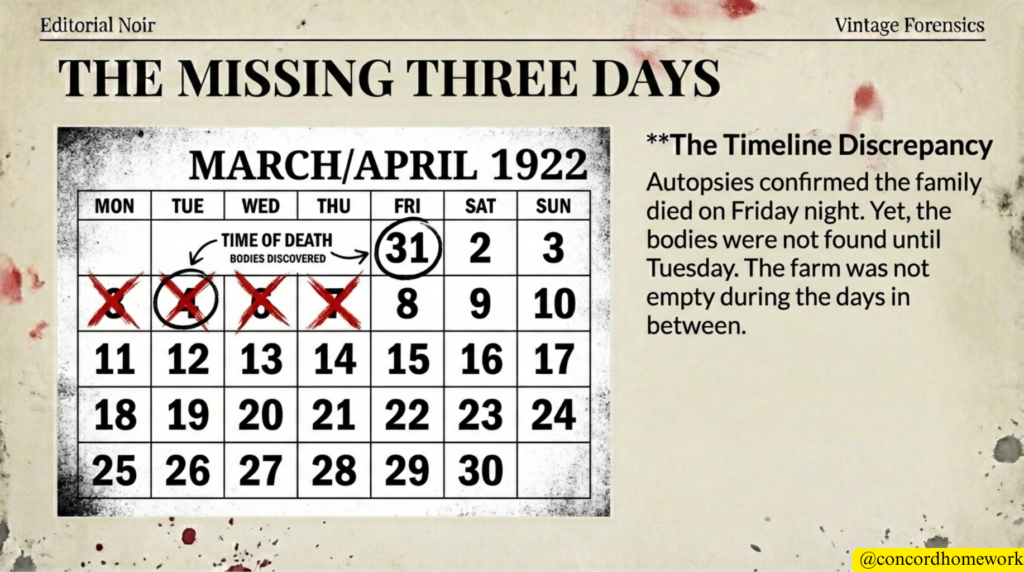
To the villagers, the Grubers were reclusive and somewhat strange, often keeping to themselves. So, when the family failed to appear at church on Sunday, April 2nd, and the young Cäzilia missed school the following Monday, few people were immediately alarmed. Neighbors assumed the family was simply busy or avoiding the harsh weather. However, as the days passed, the mail began to pile up uncollected at the postbox. The chimney, usually puffing with smoke, stood stark and cold against the grey sky. By Tuesday, April 4th, the unnatural stillness could no longer be ignored.
II. Whispers in the Walls
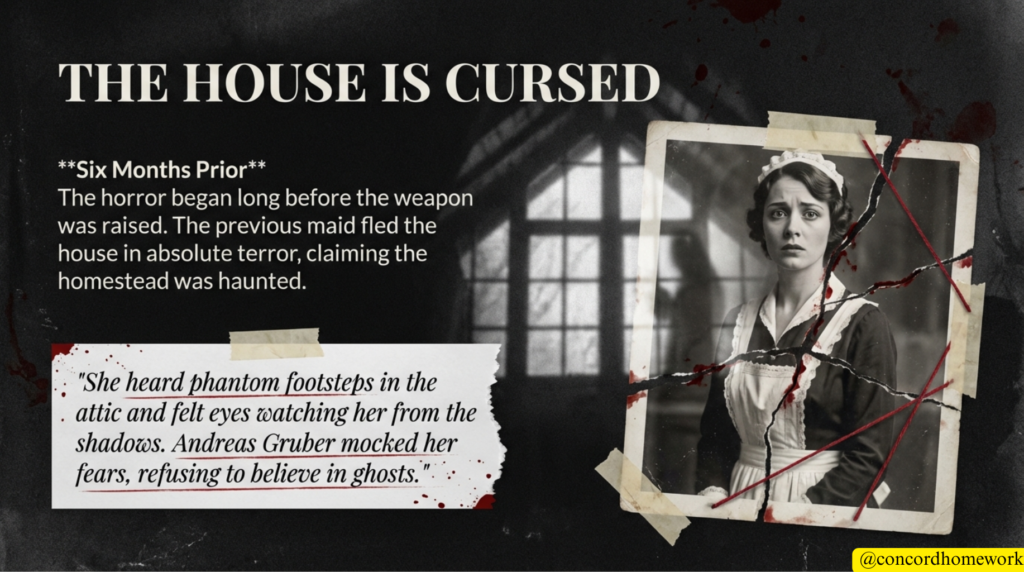
Long before the silence fell, a sense of foreboding had plagued Hinterkaifeck. Six months prior to the incident, the family’s maid had abruptly quit. She fled the house in a state of sheer panic, claiming that the farm was haunted. She told terrifying tales of hearing footsteps in the attic at night and feeling as though she were being watched from the shadows. Andreas Gruber had mocked her superstition, dismissing her fears as nonsense.
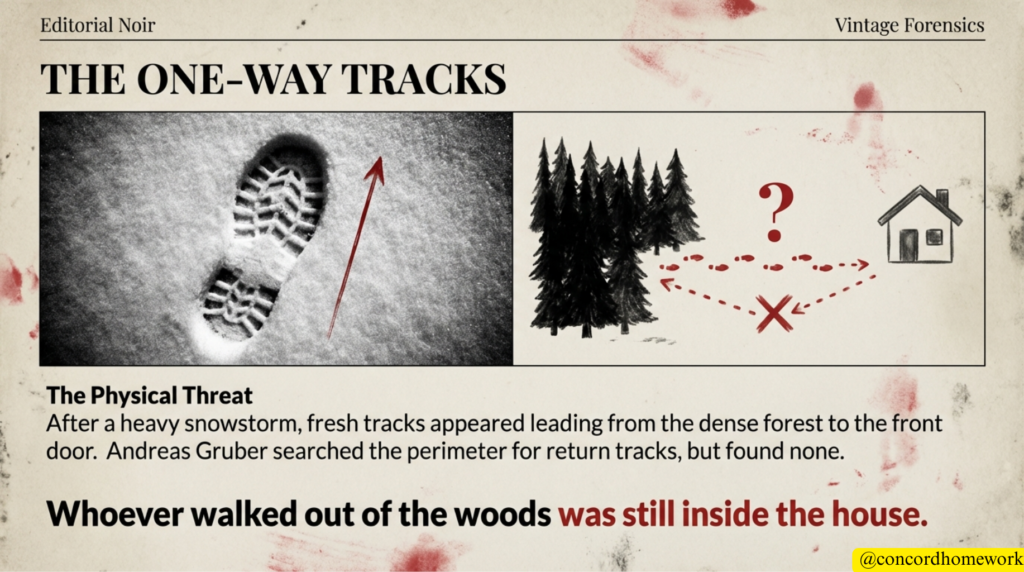
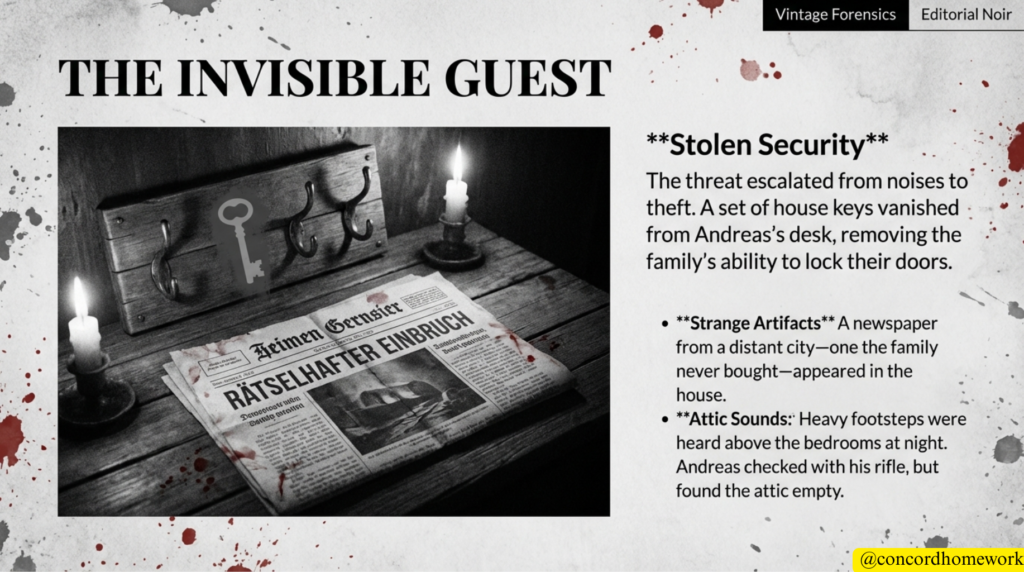
But in the weeks leading up to that fateful weekend in March, Andreas himself began to encounter inexplicable phenomena. He discovered a newspaper in the house that he had never purchased—a publication from a city miles away. A set of house keys vanished from his desk without a trace. Perhaps most chilling of all, Andreas found a set of fresh footprints in the snow. They emerged from the thick forest and led directly to the farmhouse door. When he searched for the return tracks, there were none. Whoever—or whatever—had walked out of the woods was seemingly still inside.
III. The Discovery
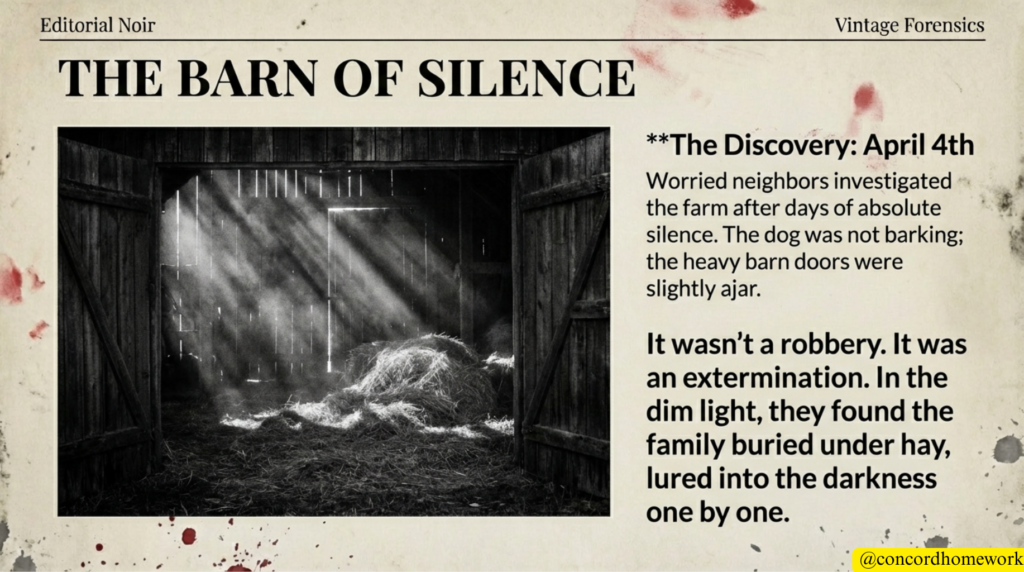
Concerned by the continued absence of the family, a group of neighbors finally decided to investigate. As they approached the farm, the silence was deafening; not even the farm dog was barking. They pushed open the heavy wooden doors of the barn and peered into the gloom.
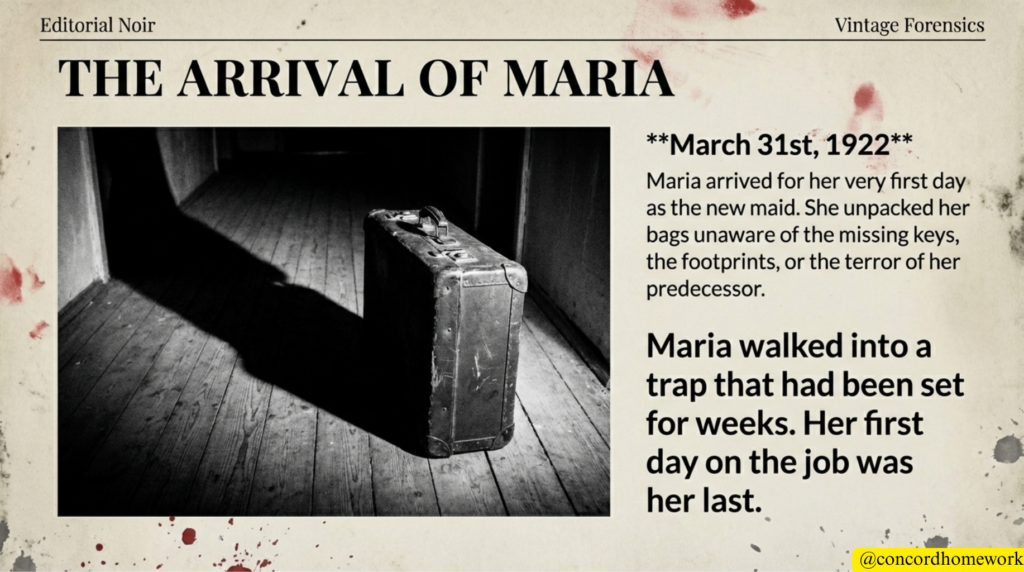
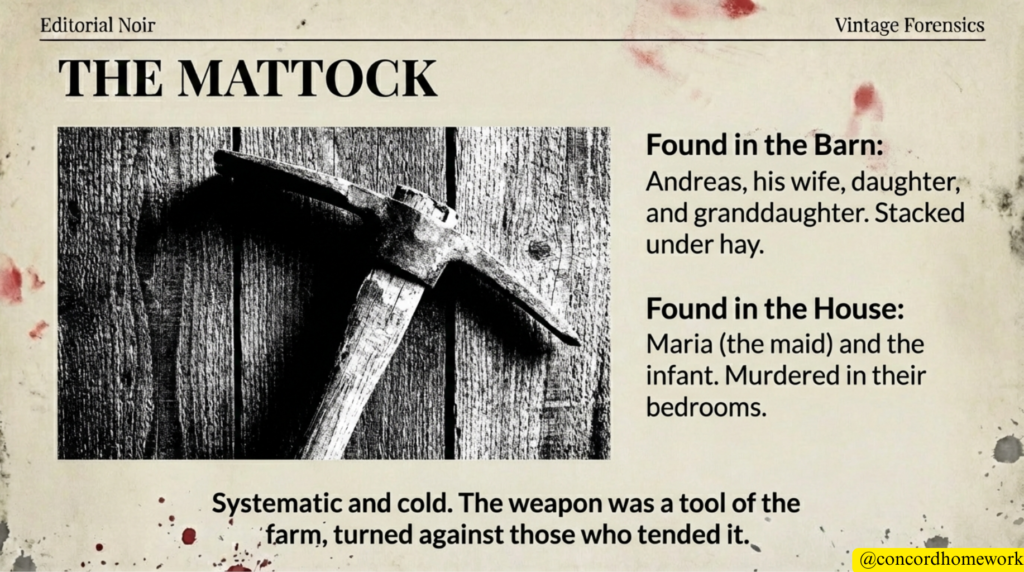
Under a makeshift covering of hay and old doors, they found a gruesome scene. The bodies of Andreas, his wife, his daughter, and his granddaughter were stacked upon one another. They had been lured to the barn one by one and struck down with a mattock, a heavy farming tool. Inside the house, the new maid, Maria—who had arrived for her first day of work only hours before her death—and the infant Josef were found in their beds. They had all been killed on the evening of Friday, March 31st.
IV. The Invisible Guest
The discovery of the bodies was horrifying, but the findings of the subsequent investigation were truly unsettling. The autopsies revealed that the family had died on Friday night. However, the neighbors discovered the bodies on the following Tuesday.
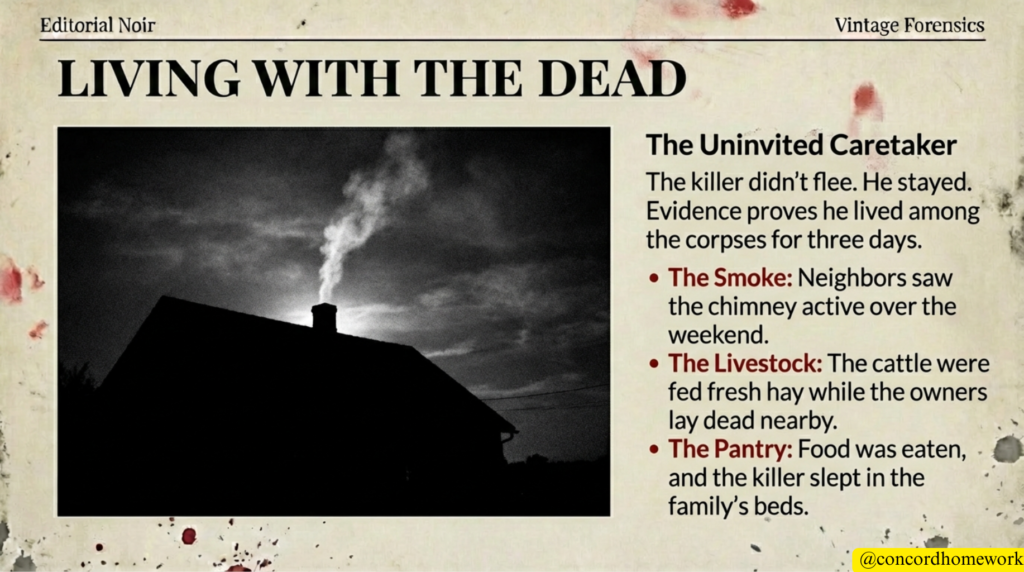
Evidence found at the scene painted a terrifying picture. Smoke had been seen rising from the chimney over the weekend. The cattle in the barn had been fed fresh hay, and food from the pantry had been eaten. Someone had not only eliminated the family but had then lived in their house for three days. The killer had slept in their beds, eaten their bread, and kept the fire warm while the victims lay in the barn just a few yards away.
A year later, when the farm was finally demolished, workers found a hollow space in the attic floorboards containing flattened hay and food wrappers. It became clear that the perpetrator hadn’t just been a passing drifter. He had been living in the attic, watching the family from above, perhaps for weeks, before finally descending to claim them. To this day, the Hinterkaifeck murders remain unsolved.
🧠 The Psychology of Human Behavior: Normalcy Bias
Why did Andreas Gruber ignore the warning signs? He found footprints leading to his house, lost his keys, and found a strange newspaper, yet he never called the police.
This can be explained by a psychological concept known as Normalcy Bias.
Normalcy Bias is a cognitive bias which leads people to disbelieve or minimize threat warnings. Consequently, individuals underestimate the likelihood of a disaster, when it might be affecting them, and its potential effects. People displaying normalcy bias have difficulties reacting to something they have not experienced before. They tend to interpret warnings in the most optimistic way possible, seizing on any ambiguity to infer a less serious situation.
In Andreas’s case, the idea of a stranger living in his attic was too terrifying and absurd to accept. Therefore, his mind rationalized the strange events: the wind caused the noises, he misplaced the keys himself, or the postman dropped the wrong newspaper. His brain prioritized “normalcy” over the terrifying reality, ultimately leading to a tragic delay in action.
📚 Key Vocabulary
- Reclusive (adj.): Avoiding the company of other people; solitary.
- Synonym: Isolated / Withdrawn
- Foreboding (n.): A feeling that something bad will happen; fearful apprehension.
- Synonym: Dread / Premonition
- Inexplicable (adj.): Unable to be explained or accounted for.
- Synonym: Baffling / Mysterious
- Gruesome (adj.): Causing repulsion or horror; grisly.
- Synonym: Horrifying / Ghastly
- Unsettling (adj.): Causing anxiety or uneasiness; disturbing.
- Synonym: Disconcerting / Alarming
- Perpetrator (n.): A person who carries out a harmful, illegal, or immoral act.
- Synonym: Culprit / Criminal
📝 Grammar Spotlight: Modals of Deduction (Past)
“The killer must have been living in the attic.”
Grammar Structure: Modal Verb (must/might/could/can’t) + have + Past Participle
Explanation:
In narrative mysteries and police investigations, we often speculate about past events when we don’t have 100% certainty. We use Modals of Deduction to express how certain we are about a past conclusion.
- Must have + V3: We are almost 100% sure it happened (Logical conclusion).
- Example: “The cattle were fed, so the killer must have stayed at the farm.”
- Might/Could have + V3: It is possible it happened (Possibility).
- Example: “The maid might have heard the killer walking upstairs.”
- Can’t/Couldn’t have + V3: We are sure it didn’t happen (Negative logical conclusion).
- Example: “Andreas couldn’t have known the killer was watching him.”
In this story, this grammar is essential because the case is unsolved. We cannot say “The killer was a neighbor.” We must say, “The killer could have been a neighbor.”
💡 Practice Activity: The Detective’s Notebook
Instructions: Complete the sentences below using the correct Modal of Deduction (must have / might have / can’t have) + Past Participle based on the evidence provided in parentheses.
- The door was locked from the inside. The killer _______________ (escape) through the window. (Logical conclusion)
- The neighbors heard nothing on Friday night. The wind _______________ (be) very loud, masking the noise. (Possibility)
- Andreas was a strong man. He _______________ (fight) back if he had seen the attacker coming. (Possibility)
- The dog didn’t bark at the intruder. The dog _______________ (know) the killer. (Logical conclusion)
- The previous maid left six months ago. She _______________ (see) the actual killer, but she definitely sensed something was wrong. (Negative logical conclusion – she left before the murder)
- The money was left on the table. The motive _______________ (be) robbery. (Negative logical conclusion)
- The killer stayed for three days. He _______________ (feel) very comfortable in the house. (Logical conclusion)
✅ Answer Key
- must have escaped
- might have been / could have been
- might have fought / could have fought
- must have known
- can’t have seen / couldn’t have seen
- can’t have been / couldn’t have been
- must have felt