

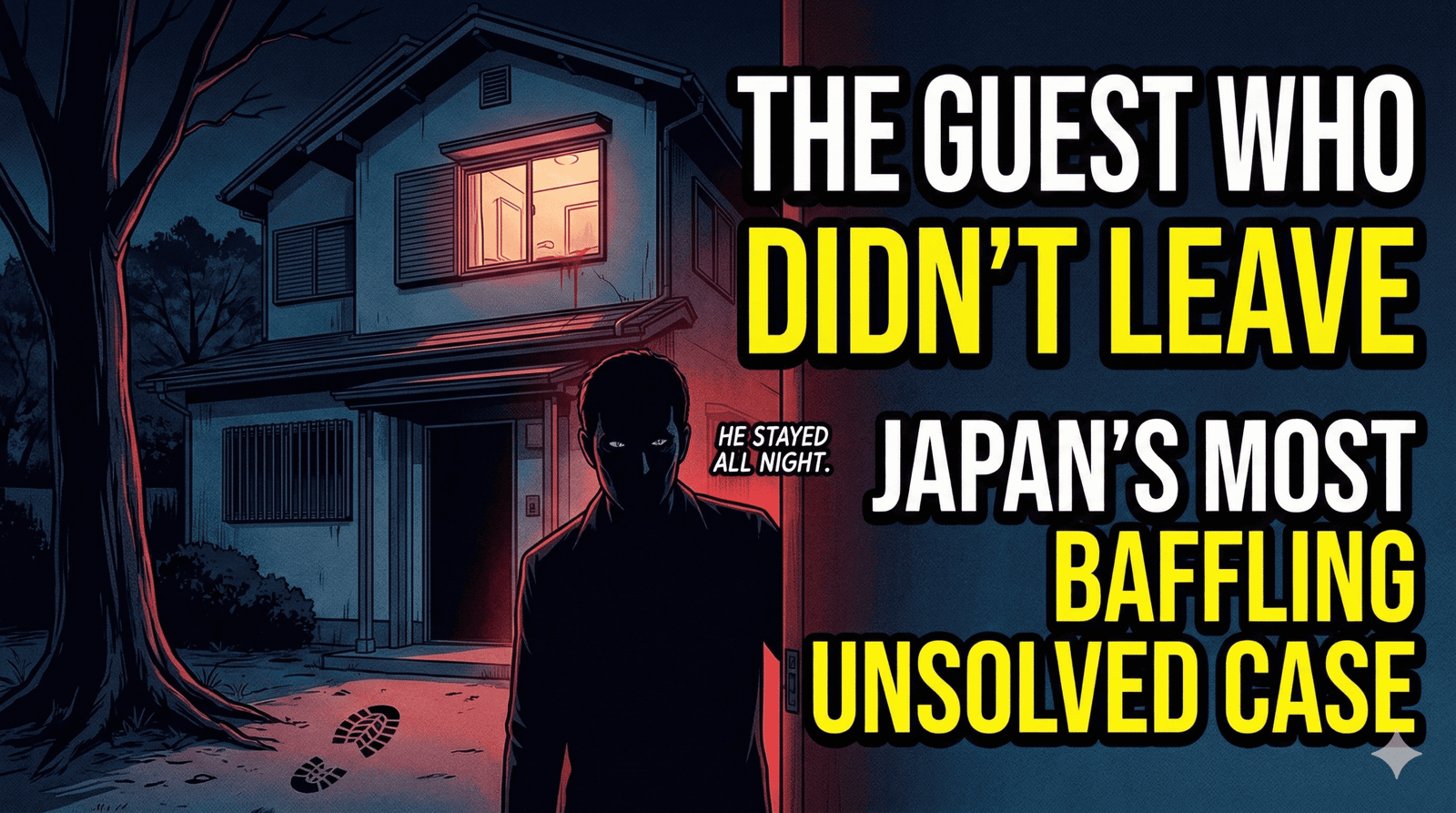
Part 1: The Silent New Year On December 31, 2000, Tokyo was a city on the edge of the future. It was New Year’s Eve, the dawn of the 21st Century. Millions of people were preparing for Omisoka, a traditional celebration of purification and family unity. But in the quiet Setagaya ward, one house stood in terrifying silence.
The Miyazawa family—father Mikio, mother Yasuko, 8-year-old Niina, and 6-year-old Rei—lived in a modern home right next to Soshigaya Park. Because the park was expanding, their neighbors had moved away, leaving the Miyazawas isolated. Their house was an island in a sea of darkness. On this specific night, that isolation would prove fatal.
Part 2: The Intrusion Police believe the intruder arrived around 11:00 PM on December 30th. He didn’t break down the front door; instead, he climbed a tree and scrambled through a small, high bathroom window on the second floor.
What followed was a tragedy. The intruder attacked the family with a sashimi knife. Mikio, the father, fought bravely on the stairs to protect his children, but he was unarmed. By midnight, the entire family had been silenced. However, the true horror of this case isn’t just the violence—it is what happened after.
Part 3: The Bizarre Aftermath Usually, criminals flee immediately after a crime due to adrenaline and the fear of being caught. But this killer didn’t run. He stayed.
Injured from the struggle, the killer began to treat the house as if it were his own. He went to the kitchen and treated his wounds using the family’s first aid kit. Then, he opened the refrigerator. He took out four cups of melon-flavored ice cream and sat in the living room, eating them calmly just meters away from his victims.
His behavior became even stranger as the night went on. He used the family’s computer to surf the internet for hours. History logs show he visited the website of the famous Shiki Theatre Company, attempting to book tickets for a play. He visited Mikio’s work website. He even took a nap on the living room sofa, sleeping soundly in the house of the dead.
Part 4: The Vanishing The intruder likely stayed until the sun came up the next morning. Before leaving, he did something baffling: he changed his clothes. He folded his own blood-stained sweater and jacket neatly and left them on the sofa. He then put on a sweatshirt belonging to Mikio and walked out of the front door, wearing the dead man’s clothes.
The grandmother, who lived next door, discovered the scene late on New Year’s morning. Despite leaving behind fingerprints, DNA, his shoes, his clothes, and even the weapon, the killer was never found. The sand in his bag was traced to the California desert, suggesting he was a traveler or a skater, but his identity remains a ghost. To this day, the Setagaya Murders remain the most perplexing unsolved case in Japanese history.
🧠 The Psychology of Human Behavior
Concept: The “Organized vs. Disorganized” Paradox
In criminal psychology, offenders are usually classified as either Organized (calculating, brings tools, leaves no evidence) or Disorganized (impulsive, leaves a messy scene, low intelligence).
The Setagaya killer is terrifying because he is a Paradox.
- Disorganized traits: He left the weapon, his own clothes, and DNA everywhere. He used the toilet without flushing. This suggests impulsivity.
- Organized traits: He entered silently via a difficult window (skill). He treated his wounds efficiently. He remained calm enough to sleep and use the computer (emotional control).
This mixture suggests a psychological profile of extreme narcissism and deviance. He didn’t leave the evidence because he was stupid; he left it because he didn’t care. He felt superior to the police, believing he would never be caught regardless of the clues he left behind.
📚 Key Vocabulary
- Isolation (noun): The state of being far away from other places or people.
- Fatal (adj.): Causing death.
- Baffling (adj.): Impossible to understand; very confusing.
- Perplexing (adj.): Completely baffling; very puzzling.
- Impulsivity (noun): The tendency to act quickly without thought for the consequences.
📝 Grammar Spotlight
Structure: Modals of Deduction (Past)
- Example: “The intruder likely stayed until the sun came up.” / “He must have felt safe.”
- Why use it? When talking about unsolved mysteries, we don’t have all the facts. We have to use “Modals of Deduction” to make guesses based on evidence.
- Must have + past participle: We are 90-100% sure (e.g., “He must have been injured because there was blood.”)
- Might have / Could have: We are 50% sure (e.g., “He might have been a skater.”)
🦉 The Owl’s Advanced Challenges
Exercise 1: Modals & Nuance Gap-Fill (Challenging) Instructions: Fill in the blanks using the correct phrase from the word bank. Be careful—there are extra words, and some distractors are grammatically incorrect for the context!
Word Bank: must have / can’t have / might have / should have / baffling / fatal / isolating / impulsivity / perplexing
The fact that the killer folded his clothes and left them behind is truly 1. __________. Looking at the crime scene, investigators concluded that he 2. __________ been in a rush to escape, as he took the time to use the family’s computer and even sleep on their sofa. Because he casually ate melon ice cream near the victims, criminal psychologists believe he 3. __________ felt a disturbing sense of superiority. This extreme arrogance, combined with his careless 4. __________ in leaving DNA everywhere, creates a psychological profile that remains 5. __________ to authorities to this day.
Exercise 2: Fact vs. Psychological Deduction (Tricky) Instructions: Read the following statements. Based strictly on the text provided, decide if the statement is a “Stated Fact” (explicitly written as an event that happened) or a “Psychological Deduction” (a theory or guess explaining why something happened based on evidence).
- The killer used the Miyazawa family’s first-aid kit to treat his injuries.
- The killer left the murder weapon and his clothes behind because he did not care if the police found them.
- The killer navigated through a small, high bathroom window on the second floor to gain entry.
- The presence of California desert sand in the bag means the killer was likely a traveler or a skater.


