

IELTS Guides · Vocabulary · ~7 min read
IELTS Vocabulary List: 2,000 Essential Words (PDF + Flashcards)
“The problem is very big and getting worse” and “the problem is acute and shows no sign of abating” describe the same idea — one is a Band 6 sentence, the other Band 8. The gap is vocabulary. Here’s the actual word list that closes it, organised the way you should study it.
Why vocabulary moves your score more than grammar does
Most Band 6 candidates already have solid grammar. What holds Writing and Speaking scores down is ordinary word choice — Lexical Resource is scored on its own in both sections, and it’s the criterion most candidates neglect in favour of grammar drilling. A well-chosen word, used the way examiners expect to see it used, does more for your band score than another grammar rule.
The 3 vocabulary tiers
Core (500 words) — the academic and band-descriptor words every candidate should own first, regardless of topic: words like mitigate, cumulative, arbitrary, discrepancy, underpin. These carry meaning in almost any Writing Task 2 essay or Speaking Part 3 answer.
Topic (1,200 words, 100 per topic) — grouped by the twelve subjects that recur constantly in Writing Task 2 and Speaking Part 3, so you can revise the exact topic your next essay or answer is about:
- Environment
- Education
- Technology
- Health
- Crime
- Urbanisation
- Work
- Globalisation
- Media
- Government
- Culture
- Transport
Precision (300 words) — the Band 8–9 upgrades that turn a correct answer into an impressive one: words like cogent, tenuous, exacerbate, unequivocal. Aimed at candidates pushing from 7 to 8+.
How to actually learn them (not just recognise them)
Flashcards teach you what a word means. They don’t teach you what it sounds like doing real work in a sentence — and that’s what examiners are listening for. The most reliable method combines both:
Frequently asked questions
How many words do I need to know for a high IELTS score?
There’s no official number, but a working vocabulary of around 2,000 words — spanning general academic vocabulary and the common Writing/Speaking topics — covers the large majority of what a Band 7+ candidate needs.
What’s the difference between Core, Topic, and Precision vocabulary?
Core words apply to any topic and should be learned first. Topic words are grouped by subject so you can revise for a specific essay or speaking theme. Precision words are Band 8–9 upgrades for candidates already scoring well.
Is memorising a word list enough to raise my score?
No — recognising a word and being able to use it naturally under pressure are different skills. Reading the word in real context and drilling it with spaced repetition both matter.
Get all 2,000 words, in context and as flashcards
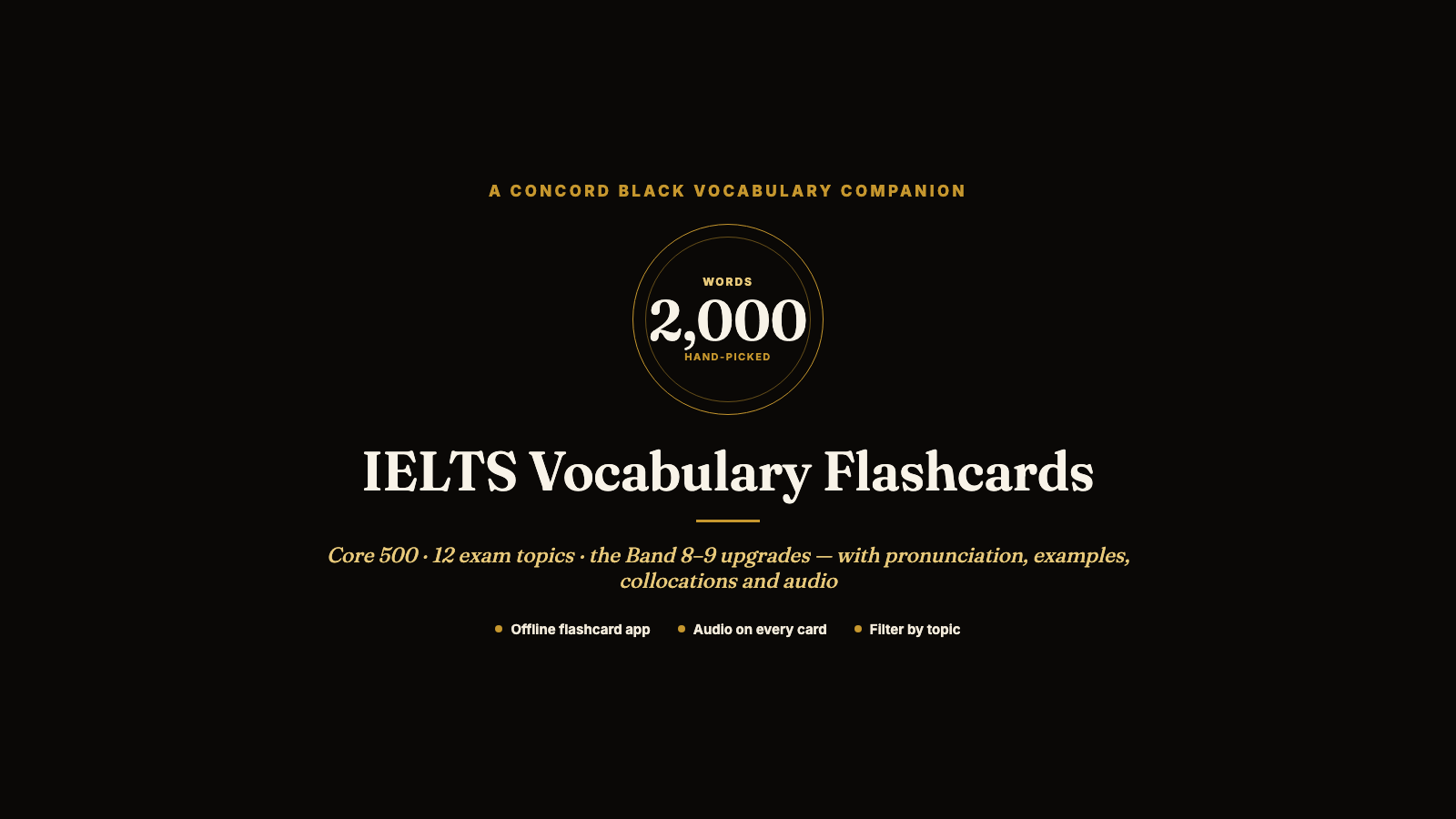
IELTS Vocabulary Mastery pairs 137 original passages using every word in real IELTS-register context with an offline flashcard app — audio on every card, organised into the same Core/Topic/Precision tiers.
Written by Dr. Henry English, founder of Concord Black — a school director with a BA in English Language and Literature, a BA in English Language Teaching, a master’s degree in English Language Teaching, and a PhD in English Language and Philosophy.
IELTS is a registered trademark of the British Council, IDP: IELTS Australia and Cambridge Assessment English. This article and the product it references are independent and not affiliated with, authorised by, or endorsed by any of those organisations.


