
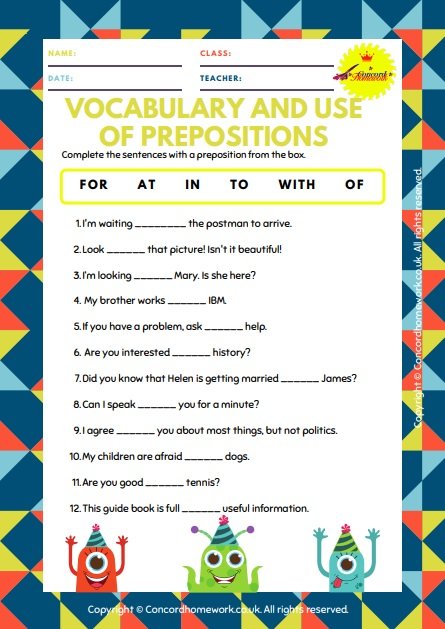
Complete the sentences with a preposition from the box.
This worksheet contains an activity about vocabulary and use of prepositions. Students read and write. The worksheet has an answer key.

Sharing is caring. Encurage our teachers to create more!
What should our team prepare for you?
What topics do you need?
In English, prepositions are small words like in, at, and for that act as the “glue” of a sentence. While they may be small, using the wrong one can completely change your meaning or make a sentence sound unnatural.
To help you master these tricky connectors, we’ve put together a guide based on common daily expressions and the specific verbs or adjectives they pair with.
Understanding Dependent Prepositions
Many prepositions in English are “dependent,” meaning they must follow a specific verb or adjective. Unlike some grammar rules, these often just need to be memorized as a pair.
Here are some of the most common pairings you will encounter:
- Waiting for: You don’t wait a person; you wait for them. (e.g., “I’m waiting for the postman.”)
- Interested in: Used when talking about hobbies or passions. (e.g., “Are you interested in history?”)
- Good at: Use this to describe a skill. (e.g., “Are you good at tennis?”)
- Afraid of: Use this to describe a fear. (e.g., “Children are often afraid of dogs.”)
- Full of: Used to describe containing a lot of something. (e.g., “This book is full of useful information.”)
Prepositions with People and Communication
When interacting with others, the preposition you choose defines the relationship of the action:
- Speak to/with: Both are acceptable when having a conversation.
- Agree with: Used when you share the same opinion as someone else.
- Married to: A common mistake is to say “married with,” but in English, you are always married to someone.
- Ask for: When you need assistance, you ask for help.
Quick Reference Table
Use this table to study the correct prepositional links for various common phrases:
| Verb / Adjective | Correct Preposition | Example Sentence |
| Wait | For | I am waiting for the bus. |
| Look | At | Look at that beautiful sunset! |
| Look | For | I am looking for my lost keys. |
| Work | For / At | He works for Google / He works at the office. |
| Ask | For | You should ask for a raise. |
| Interested | In | She is interested in modern art. |
| Married | To | He is married to a famous doctor. |
| Speak | To / With | Can I speak to you about the project? |
| Agree | With | I agree with your decision. |
| Afraid | Of | Many people are afraid of spiders. |
| Good | At | She is very good at solving puzzles. |
| Full | Of | The jar is full of cookies. |
Pro Tip for Learners
When you learn a new verb or adjective, don’t learn it alone! Always learn it with its “partner” preposition. Instead of just learning “interested,” learn it as “interested in.” This will help you speak more fluently and avoid common translation errors.