

Here is the fully formatted and proofread worksheet, complete with your branding, clean typography, and corrected numbering for a professional presentation.
ESL Reading & Vocabulary Worksheet
Topic: The Architecture of Malice (The Joel Guy Jr. Case)
Level: C2 (Proficient / Mastery)
Focus: Narrative Reading, Psychological Analysis, and Advanced Lexis
Materials provided by: concordhomework.com | @DrHenryEnglish 🦉
Part 1: The Reading Text
I. The Foreboding Stillness on Goldenview Lane
It was late November 2016 in Knoxville, Tennessee, and the ephemeral warmth of the Thanksgiving holiday had already begun to dissipate. The affluent, leafy enclave of Goldenview Lane had settled back into its prosaic routine; most families were returning to their professional obligations, attempting to shake off the collective lethargy induced by the protracted holiday weekend. Yet, at the meticulously maintained residence of Joel and Lisa Guy, the stillness was not merely quiet—it was palpably unnatural, hanging in the air with a foreboding weight.
Joel Sr., an industrious pipeline engineer, and Lisa, an accounts payable administrator, were universally regarded as the paragons of reliability. They were an unequivocally devoted couple in their early sixties, standing on the precipice of a well-deserved retirement, eager to relish the twilight of their careers. Consequently, when Lisa conspicuously failed to appear at her office on Monday morning—and her phone went inexorably unanswered—a pervasive unease rippled through her colleagues. It was profoundly incongruous with her meticulous nature to vanish without a trace or a preemptive explanation. By midday, driven by escalating apprehension, a concerned coworker petitioned the local constabulary for a welfare check.
Upon their arrival at the imposing, two-story brick edifice, the responding officers were immediately struck by a profound dissonance. Ostensibly, all was well: the family vehicles remained parked symmetrically in the driveway, and the festive Christmas illumination had already been erected, signaling impending seasonal joy. However, as the officers approached the formidable wooden threshold, their instincts alerted them to a sinister anomaly. An inexplicable, oppressive heat was radiating through the sturdy door, and a faint, acrid miasma—a distinctly chemical olfactory assault—drifted insidiously through the microscopic fissures of the door frame.
II. The Macabre Tableau and the Stifling Crucible
Breaching the entryway, the authorities were instantaneously engulfed by an impenetrable wall of stifling, viscous air. The thermostat had been deliberately manipulated to an agonizing 30°C (90°F), transforming the suburban domicile into a suffocating crucible. While the oppressive thermal conditions were staggering, it was the overwhelming stench that fundamentally assaulted the senses—a grotesque, stomach-churning amalgamation of industrial-grade corrosives and the unmistakable, sweet putrefaction of biological decay.
In jarring juxtaposition to this sensory nightmare, the immediate interior of the house maintained an immaculate veneer. The plush furnishings were perfectly arranged, and the holiday garlands hung undisturbed, projecting a macabre illusion of domestic tranquility. Yet, as the officers cautiously navigated deeper into the labyrinth of the home, this facade of normalcy comprehensively disintegrated. They encountered haphazard mounds of discarded clothing and gaping, hastily packed suitcases strewn across the floorboards. In the culinary heart of the home, large stockpots simmered ominously on the stove, the gas burners still radiating an eerie, blue intensity.
The ensuing discovery was of such a gruesome magnitude that it defied conventional articulation. It became horrifyingly apparent that the homeowners, Joel and Lisa, were not victims of a spontaneous abduction or a transient disappearance; they had been subjected to an atrocity of unspeakable brutality. Crucially, this was entirely devoid of the hallmarks of a crime of passion or a botched home invasion. The environment was a painstakingly orchestrated tableau. The perpetrator had embarked upon a diabolical endeavor to entirely liquefy the forensic evidence utilizing caustic chemical agents and extreme thermal manipulation, effectively transmuting the sanctity of the family home into a clandestine, nightmarish laboratory.
III. The Parasitic Progeny
Who possessed the chilling requisite malice to orchestrate such a heinous desecration against a universally beloved couple? The investigative lens rapidly pivoted toward the immediate familial circle who had occupied the residence during the holiday festivities. The Guys were the progenitors of four children, three of whom had seamlessly assimilated into adulthood, cultivating autonomous, prosperous lives. Conversely, their 28-year-old son, Joel Guy Jr., represented a stark, troubling dichotomy.
Joel Jr. had languished in a state of perpetual academic stagnation as a “professional student” at Louisiana State University for the better part of a decade. Devoid of gainful employment, independent income, or a substantive social network, his entire earthly existence was inextricably subsidized by his parents’ unwavering altruism. They underwrote his exorbitant rent, his tertiary tuition, and his mundane living expenses. Nevertheless, with the specter of retirement looming, Joel Sr. and Lisa had arrived at a painful but necessary consensus: the unilateral financial umbilical cord had to be severed. They had explicitly resolved to terminate his stipend immediately following the Christmas holidays.
Joel Jr. had arrived for the Thanksgiving feast fully cognizant of this impending financial destitution. With chilling sangfroid, he partook in the traditional poultry, engaged in superficial banter with his sisters, and smiled placidly for the family archives. To the uninitiated observer, he was entirely unremarkable. Yet, behind his impenetrable, bovine expression, the gears of a malevolent machination were already grinding toward execution.
IV. The Architecture of Malice
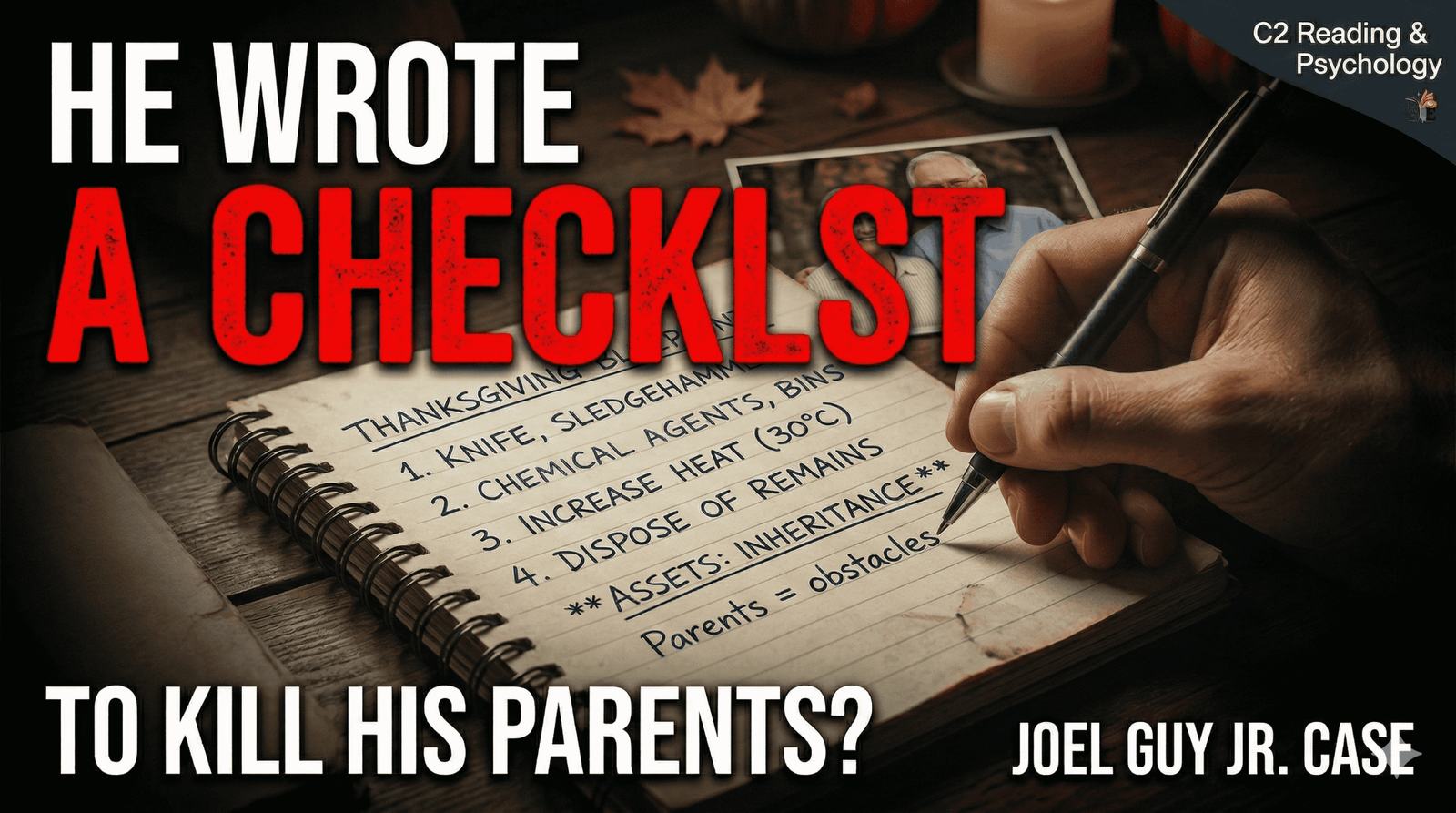
The most profoundly disturbing artifact of the investigation was not unearthed amidst the ruin of the crime scene, but rather securely sequestered within Joel Jr.’s mundane backpack following his subsequent apprehension. It was an unassuming, spiral-bound ledger. Within its innocuous pages, investigators uncovered a veritable masterclass in premeditated malice—pages replete with meticulous, handwritten directives.
This document was not the erratic diary of a mind fractured by sudden, uncontrollable rage; it was a clinical, sequential checklist. Joel Jr. had authored an exhaustive, step-by-step manifesto detailing the slaughter of his parents and the subsequent eradication of their mortal remains. He cataloged the requisite implements of destruction: specialized cutlery, blunt-force bludgeons, specific caustic solvents, and heavy-duty polyethylene receptacles. Most damningly, he had callously tabulated the “assets”—the pecuniary windfall he anticipated inheriting upon their untimely demise.
The ledger unequivocally demonstrated that the patricide and matricide were fundamentally transactional. He did not perceive his parents as sentient beings to whom he owed his existence, but rather as mere logistical impediments to his parasitic lifestyle. He had nurtured this “blueprint” for weeks, strategically procuring his macabre inventory across a disparate array of retail outlets to subvert suspicion. Ultimately, his architectural design for the perfect murder collapsed under the weight of his own hubris; he had catastrophically miscalculated the temporal investment required to chemically obliterate the evidence, compelling him to precipitously abandon the theater of his crimes before his gruesome alchemy was complete.
In 2020, following a harrowing trial, Joel Guy Jr. was convicted and condemned to life imprisonment. As the definitive verdict echoed through the courtroom, he maintained an impenetrable facade of apathy, sitting as stoically and silently in the docket as he had at the Thanksgiving table, a chilling testament to the absolute banality of his evil.
Part 2: Comprehension & Language Analysis
1. Advanced Vocabulary in Context
In Paragraph 3, the author writes: “He had languished in a state of perpetual academic stagnation… his entire earthly existence was inextricably subsidized by his parents’ unwavering altruism.”
Based on the context of the passage, which of the following best describes the contrast the author is making?
A) The contrast between Joel Jr.’s high intelligence and his inability to find a well-paying job.
B) The contrast between Joel Jr.’s deliberate laziness and his parents’ continuous, selfless financial support.
C) The contrast between the parents’ immense wealth and Joel Jr.’s desire to live a humble, academic life.
D) The contrast between the university’s difficult curriculum and Joel Jr.’s eventual academic triumph.
2. Grammatical Structure & Syntax
Read the following sentence from Section II:
“While the oppressive thermal conditions were staggering, it was the overwhelming stench that fundamentally assaulted the senses—a grotesque, stomach-churning amalgamation of industrial-grade corrosives and the unmistakable, sweet putrefaction of biological decay.”
What grammatical structure is primarily used in the phrase “it was the overwhelming stench that fundamentally assaulted the senses” to place special emphasis on the smell rather than the heat?
A) A third conditional clause
B) A passive voice construction
C) A cleft sentence
D) A past perfect continuous phrase
3. Deep Comprehension & Inference
According to the text, why did Joel Guy Jr.’s “perfect crime” ultimately fail, leading to his capture?
A) He carelessly left his meticulously detailed notebook at the crime scene for the police to find.
B) His sisters noticed his strange behavior during Thanksgiving dinner and alerted the authorities beforehand.
C) His arrogance led him to underestimate the amount of time required to completely dissolve the physical evidence, forcing him to flee prematurely.
D) He purchased all of his tools and chemicals at a single store, making it easy for investigators to track his movements.
Part 3: Definition Matching
Draw a line or write the corresponding letter to match the advanced vocabulary word from the text (1-8) with its correct definition (A-H).
1. Miasma (n.) _____
2. Putrefaction (n.) _____
3. Sangfroid (n.) _____
4. Languish (v.) _____
5. Progenitor (n.) _____
6. Pecuniary (adj.) _____
7. Hubris (n.) _____
8. Incongruous (adj.) _____
Definitions:
A. Excessive pride, arrogance, or dangerous overconfidence.
B. A biologically related ancestor; a parent or forebear.
C. Composure or extreme coolness, especially in dangerous or trying circumstances.
D. The process of decay or rotting in a body or other organic matter.
E. Not in harmony or out of place with the surroundings or other aspects of something.
F. Relating to or consisting of money; financial.
G. An oppressive, unpleasant atmosphere, or a highly unwholesome smell.
H. To fail to make progress; to suffer from being forced to remain in an unpleasant situation.
Part 4: Sentence Gap-Fill
Complete the following sentences using the correct word from the vocabulary list in Part 3. You may need to change the word form (e.g., verb tense or pluralization) depending on the context.
- The detective noted how completely ____________ it was for such a meticulous, organized woman to leave her front door wide open and her purse on the lawn.
- Despite being surrounded by the chaos of a hostage situation, the lead negotiator maintained an absolute ____________, speaking calmly and softly into his radio.
- The tragic criminal’s ultimate downfall was brought about by his own ____________; he genuinely believed he was much smarter than the investigators pursuing him.
- When the investigators opened the sealed basement door, a terrible ____________ drifted up the stairs, forcing them to step back and cover their faces.
- Without any fresh challenges or professional guidance, the brilliant student began to ____________ in his small hometown, achieving nothing of note for over a decade.
- Due to the extreme heat in the closed apartment, the forensic team had to wear specialized respirators to tolerate the advanced stages of ____________.
- While the suspect claimed his motives were purely emotional, the prosecution soon discovered his ____________ interest in the victim’s multi-million-dollar life insurance policy.
- As the ____________ of the wealthy dynasty, the patriarch demanded absolute loyalty and obedience from all of his children and grandchildren.
Teacher’s Answer Key (@DrHenryEnglish Eyes Only)
Part 2: Comprehension & Language Analysis
1. B
Explanation: “Languished” and “stagnation” imply a lack of progress or deliberate laziness, while “subsidized” and “altruism” point to his parents paying for everything out of selfless love. The text highlights his parasitic nature against their generosity.
2. C
Explanation: The structure “It was [X] that [Y]” is a cleft sentence. Cleft sentences are used to focus on or emphasize a specific part of a sentence—in this case, emphasizing that the stench was the primary assault on the senses, not the heat.
3. C
Explanation: Section IV explicitly states: “his architectural design for the perfect murder collapsed under the weight of his own hubris; he had catastrophically miscalculated the temporal investment required to chemically obliterate the evidence, compelling him to precipitously abandon the theater of his crimes…” Option A is incorrect because the notebook was found in his backpack after his arrest, not at the scene.
Part 3: Definition Matching
1. Miasma – G (An oppressive, unpleasant atmosphere, or a highly unwholesome smell.)
2. Putrefaction – D (The process of decay or rotting in a body or other organic matter.)
3. Sangfroid – C (Composure or extreme coolness, especially in dangerous or trying circumstances.)
4. Languish – H (To fail to make progress; to suffer from being forced to remain in an unpleasant situation.)
5. Progenitor – B (A biologically related ancestor; a parent or forebear.)
6. Pecuniary – F (Relating to or consisting of money; financial.)
7. Hubris – A (Excessive pride, arrogance, or dangerous overconfidence.)
8. Incongruous – E (Not in harmony or out of place with the surroundings or other aspects of something.)
Part 4: Sentence Gap-Fill
- incongruous
- sangfroid
- hubris
- miasma
- languish
- putrefaction
- pecuniary
- progenitor


%20vocabulary%20with%20this%20gripping%20true%20crime%20reading%20lesson%20on%20the%20Joel%20Guy%20Jr.%20case.%20Explore%20the%20psychology%20of%20instrumental%20aggression%20and%20test%20your%20reading%20comprehension.)