

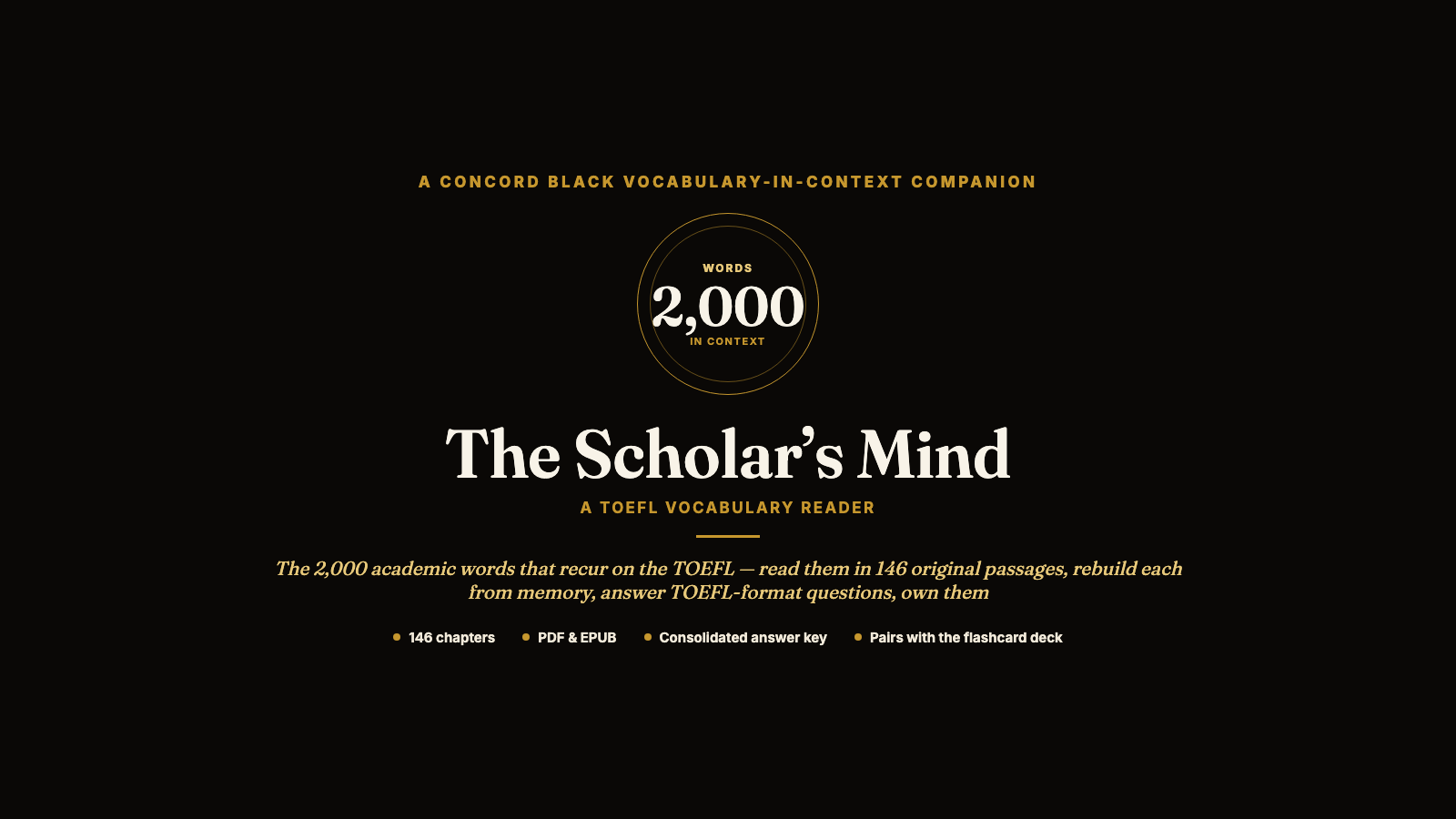
The Scholar’s Mind â A TOEFL Vocabulary Reader
The 2,000 academic words that recur on the TOEFL iBT, taught in 146 original academic passages instead of a word list. Read each passage, rebuild a summary of it from memory, then answer TOEFL-format “closest in meaning” questions with no word bank â the exact vocabulary-in-context loop the Reading section rewards. Core 500, 12 academic subjects, and 300 score-topping Precision words. PDF + EPUB, consolidated answer key.
$9 · instant download · PDF + EPUB
Get the bookSecure checkout on Gumroad · free lifetime updates
This is a vocabulary book for the TOEFL iBT. It teaches academic words and how to read them at speed; it is not a four-skills course.
On the TOEFL, you don’t lose points because your English is broken. You lose them because a passage uses a word you half-know, and the clock doesn’t wait.
Here is the Reading section as most test-takers live it: you understand the sentences. Grammar is not the problem. But every few lines there is a word you half-know â constitute, empirical, attribute, salient, tenuous, corroborate â and each one costs a second while your eyes double back. Twenty of those in a passage, three passages, and the questions you needed those minutes for are still sitting there when the timer stops. Listening is the same at speed.
Speed on academic vocabulary is a skill, and it is built the way any reading skill is built: by meeting the words in real sentences, again and again, until they disappear into the meaning. A bare word list can’t do that. This book can.
What it is
The Scholar’s Mind takes the same 2,000 words as the companion TOEFL Vocabulary Flashcards deck and puts every one of them to work in an original academic passage, then makes you use it. Each of the 146 chapters is one cluster of 12â15 words that belong together, and it moves through the same sequence:
- The Frame â three or four sentences on the kind of thinking this cluster lets you do, stated as a capability you’re about to have, not a list of definitions.
- The Passage â 300 to 400 words of original academic English at exactly the register and difficulty the TOEFL uses, with the target words in bold. Read it once, for meaning, without stopping.
- Recall â an 80â120-word summary of the passage with the target words removed. Fill it from memory before you look at the word bank. The effort of pulling the word out is what lays the track down.
- Infer â three or four questions in the exact form the TOEFL Reading section uses: “the word X in the passage is closest in meaning to⦔. No word bank. Work it out from the sentence around it.
- The Shift â two or three sentences naming what you can now do that you couldn’t before, and what it feels like to use it.
- Say It, Own It â write, and then say aloud, one sentence of your own using two of the chapter’s words about something real to you. Thirty seconds; the step most readers skip and the one that does the most.
- A link and a code â open the companion deck already filtered to this exact cluster, and drill it with audio over the following week.
The three tiers
- Core (36 chapters, ~500 words). The academic “signal” vocabulary that carries the meaning in every passage regardless of subject â the verbs of argument, the connectives, the adjectives of degree and certainty. Own this layer and it never changes from one passage to the next.
- Topic (88 chapters, ~1,200 words). The twelve academic domains TOEFL draws from, about a hundred words each, grouped so you can study a subject as a set â the exact register of a biology passage, a history lecture, an economics essay â and walk into its passages already knowing the vocabulary.
- Precision (22 chapters, ~300 words). The hardest, most exact words on the list â the near-synonyms that mark how a writer is hedging, committing, softening, or attacking. Clusters here are built around the argument move the words make, because that’s what the questions test.
How the words were chosen
Nobody outside ETS has the past papers. But “the words that come up over and over” is a measured thing. This list was built by working down the merged academic-frequency ranking â Coxhead’s Academic Word List, the Academic Vocabulary List drawn from the 120-million-word academic corpus of COCA, and the New Academic Word List â then filtered against a general-English frequency list so nothing everyday takes a slot. It is the recurring academic vocabulary of the register the TOEFL is written in.
The front chapter
“How Vocabulary Becomes You” is a short chapter you read before Part 1. It lays out the five findings from memory research the whole book is built on â Ebbinghaus on spacing, Roediger & Karpicke on retrieval practice, Craik & Lockhart on elaboration, Bjork on desirable difficulty, Slamecka & Graf on the generation effect â and shows exactly which part of every chapter trains which one. Nothing mystical: the claim is simply that knowing a word and thinking with it are two different states, and this book is engineered to move you from the first to the second.
Who it’s for
Anyone preparing for the TOEFL iBT whose grammar is already solid but who slows down or second-guesses on academic vocabulary â which costs most in Reading and Listening, where the clock is tight. Useful from the first week of prep; the Precision tier is for test-takers pushing an already-good score higher.
Who’s behind it
Written by Dr. Henry English, founder of Concord Black â who holds a BA in English Language and Literature, a BA in English Language Teaching, a master’s degree in English Language Teaching, and a PhD in English Language and Philosophy, and has spent years watching capable students read every word of a passage and still run out of time, because nobody drilled the academic vocabulary until it was automatic.
Get the 2,000 recurring TOEFL words taught in 146 original passages, with two TOEFL-format exercises per chapter and a consolidated answer key â PDF and EPUB, for $9.
—
| Format | Book â print-quality PDF (491 pp) + reflowable EPUB 3 |
|---|---|
| Words | 2,000 (Core 500 · 12 subjects à ~100 · Precision 300) |
| Chapters | 146 (Core 36 · Topic 88 across 12 domains · Precision 22) |
| Per chapter | The Frame · a 300â400-word academic passage (target words in bold) · Recall (prose-summary cloze, from memory) · Infer (3â4 TOEFL “closest in meaning” items, no word bank) · The Shift · Say It, Own It · a link + QR to the companion deck |
| Answer key | One consolidated section at the back â Recall and Infer answers for all 146 chapters |
| Level | Targets a rising Reading/Listening score; sentences around the target words are kept at B1âB2 so the vocabulary is the only difficulty |
| Conventions | American spelling throughout; academic register modelled on real TOEFL passages and lectures |
| Companion | The reading half of the TOEFL Vocabulary System; pairs with TOEFL Vocabulary Flashcards (same 2,000 words, same tiers) |
| Delivery | Instant â PDF and EPUB, both files |
| Updates | Free, for life |
Frequently asked questions
What format is it?
PDF plus a reflowable EPUB. The EPUB reads on Kindle, Apple Books, Kobo and any phone; the PDF is best for desktop and printing.
What devices does it work on?
Phone, tablet, laptop, e-reader, or printed. Nothing to install.
Is this an official TOEFL product?
No. TOEFL is a registered trademark of Educational Testing Service (ETS). This is an independent study aid and is not affiliated with, authorised by, or endorsed by ETS. It teaches academic vocabulary and reading; it is not a four-skills course.
How do I get it after paying?
Gumroad shows the download immediately and also emails you a permanent link. There is no account to create.
Refunds?
Because it is an instant digital download, all sales are final. If a file is broken or won’t open, email and it will be fixed.
Are updates free?
Yes â if it is revised, you get the new version free, for life.
TOEFL is a registered trademark of Educational Testing Service (ETS). This is an independent study aid and is not affiliated with, authorised by, or endorsed by ETS. It teaches academic vocabulary and reading; it is not a four-skills course.