

Part 1: The Reading Text
The Silence of Blackwood Lane
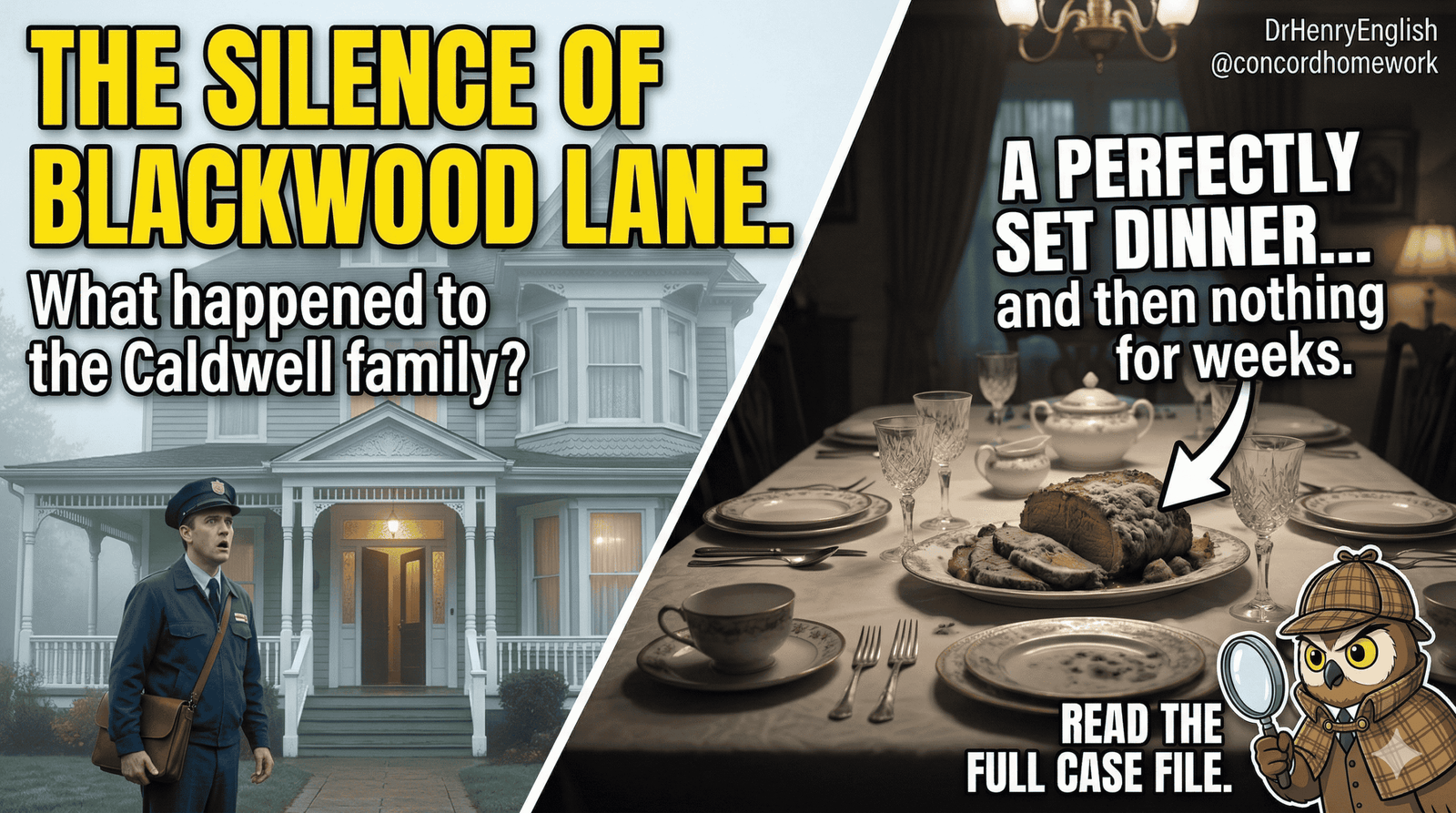
I. The Unsettling Discovery On the morning of November 14th, 1994, the town of Oakhaven, Oregon, was blanketed in a heavy, suffocating mist. It was a Tuesday, typically a noisy day of routine, but for Arthur Miller, the local postman, the silence was the first warning sign. As he approached the sprawling Victorian estate at 42 Blackwood Lane, he realized the familiar sounds of construction—the buzzing saws and hammering that had plagued the neighborhood for months—had completely ceased.
Arthur noticed the front door standing slightly ajar, swaying rhythmically in the damp draft. Driven by an instinctive worry, he stepped inside. The scene that greeted him was not one of chaotic violence, but of eerie stillness. In the dining room, a table was perfectly set for four people with fine china and crystal glasses. However, the roast beef dinner on the plates was covered in a thick, fuzzy layer of grey mold. It had been sitting there, untouched, for weeks. The Caldwell family—Elias, Sarah, and their two children—had vanished, leaving their wallets on the counter and their cars in the driveway. The house wasn’t empty; it felt as though it was holding its breath.
II. The Architect’s Obsession To understand the tragedy, one must look at the father, Elias Caldwell. Elias was a renowned structural engineer, a man who viewed the world through angles, stress loads, and blueprints. He believed that a building’s integrity dictated the happiness of those inside it. When he bought the derelict Blackwood property in 1993, he viewed it as a blank canvas to build a “fortress of solitude” for his wife, Sarah, and their children, Leo and Mia.
However, Elias’s behavior soon shifted from dedicated renovation to paranoid obsession. He fired his contractors, convinced they were “compromising the seal” of the home. He began working alone, often through the night, insulating the walls with heavy, industrial materials and boarding up windows with triple-paned glass. He told his wife that the outside world was “leaking in” and that he needed to correct the angles. To his neighbors, he was a diligent father; in reality, he was constructing a cage.
III. The Slow Constriction By October, the family had effectively disappeared. The children were withdrawn from school, and Sarah stopped attending her volunteer shifts. Neighbors reported strange mechanical humming sounds emanating from the property late at night, like a massive generator running deep underground. When police conducted a welfare check, Elias appeared at the door covered in plaster dust, gaunt and exhausted, yet polite. He assured them they were simply remodeling. Sarah, standing in the shadows behind him, looked “dimmed,” avoiding eye contact and glancing fearfully at the hallway behind her.
Then, the noise stopped. For two weeks, the house sat in absolute silence until Arthur Miller walked through the open door.
IV. The Sealed Chamber When Detective Mark Henderson arrived to investigate the disappearance, he noted that the interior dimensions of the house felt wrong. The hallways seemed too long; the rooms felt unnaturally narrow. The search eventually led them to the basement, Elias’s workshop. There, they found a freshly built wall bisecting the cellar. It was not hollow drywall; it was a dense, solid barrier.
After twenty minutes of sledgehammering through layers of concrete, lead, and soundproofing foam, the police breached the wall. Inside, they found a hidden, hermetically sealed room—a “room within a room.” Seated inside were the bodies of the Caldwell family. They looked peaceful, dressed in their Sunday best, having succumbed to carbon monoxide poisoning from a generator rigged to the ventilation system.
Elias had left a journal explaining his “Project.” He believed a catastrophic “frequency” was coming to destroy the world. In a twisted act of love, he had built a vacuum—an ark of silence—to save his family. He hadn’t murdered them out of hate; he had ended their lives to “preserve” them from a danger that existed only in his mind.
Part 2: The Psychology of Human Behavior
Concept: Delusional Disorder & The Savior Complex
In this case, Elias Caldwell likely suffered from a severe form of Delusional Disorder, specifically with persecutory and grandiose themes. Unlike schizophrenia, where a person might hallucinate, people with delusional disorder can often function normally in society (appearing polite to police), but they hold a fixed, false belief that cannot be changed by logic.
Elias combined this with a twisted Savior Complex. This occurs when a person feels a compulsive need to “save” others, often creating a situation where the others need saving. Elias believed the outside world was an imminent threat (the “great frequency”). His engineering background allowed him to rationalize this delusion—he didn’t use magic; he used physics and architecture to “solve” the problem. The tragedy lies in the fact that his motivation was protection, but his method was destruction. This is often seen in “family annihilator” cases, where the father believes he is sparing his family from a worse fate.
Part 3: Key Vocabulary
- 1 Cacophony(Noun)
- Definition: A harsh, discordant mixture of sounds.
- Synonym: Clamor / Din
- Derelict(Adjective)
- Definition: In a very poor condition as a result of disuse and neglect.
- Synonym: Dilapidated / Ruined
- Integrity(Noun – Technical Context)
- Definition: The state of being whole and undivided; the structural strength of a building.
- Synonym: Soundness / Stability
- Emanating(Verb – Continuous)
- Definition: (Of something abstract but perceptible) issuing or spreading out from a source.
- Synonym: Radiating / Originating
- Gaunt(Adjective)
- Definition: Lean and haggard, especially because of suffering, hunger, or age.
- Synonym: Emaciated / Skeletal
- Bisecting(Verb – Continuous)
- Definition: Dividing something into two parts (usually equal parts).
- Synonym: Cutting / Splitting
- Hermetically(Adverb)
- Definition: In a way that is completely airtight.
- Synonym: Tightly / Sealed
Part 4: Grammar Spotlight
Grammar Structure: Past Perfect Simple vs. Past Simple
Sentence from Text:
“The roast beef dinner on the plates was covered in a thick, fuzzy layer of grey mold. It had been sitting there, untouched, for weeks.”
Explanation: This story uses narrative tenses to manage the timeline. We are standing in the “past” (when the postman found the body). However, we need to talk about an action that started before that moment and continued up until that moment.
- Past Simple: “The postman found the dinner.” (This is the main timeline).
- Past Perfect Continuous: “It had been sitting there.”


