

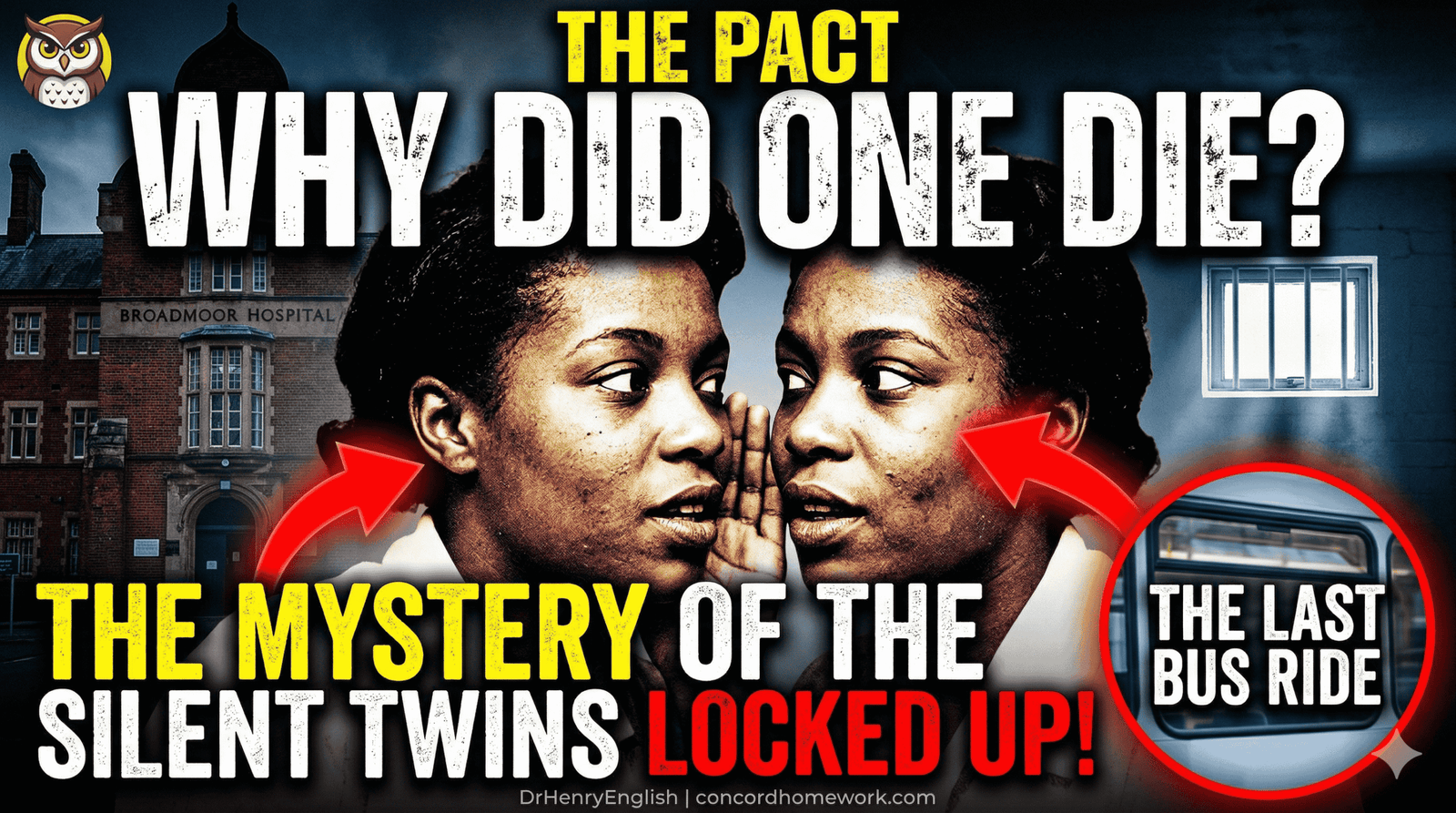
The Silent Twins: A Pact of Shadows
Part 1: The Invisible Wall
In the bustling town of Haverfordwest, Wales, during the 1970s, the Gibbons family seemed remarkably ordinary to outsiders. However, inside their home, a bizarre and unsettling reality was unfolding. June and Jennifer Gibbons, identical twin sisters born in 1963, had created a private world that no one else could enter. From a young age, they refused to speak to anyone but each other. Even their parents were excluded from their secret language—a high-speed form of Bajan Creole that was unintelligible to the uninitiated ear.
Teachers and psychologists were baffled by their behavior. The girls would mirror each other’s movements with eerie precision. If one scratched her nose, the other would do the same instantly. They walked in perfect synchronization, ate at the same pace, and even breathed in rhythm. This wasn’t just a childhood game; it was a pathological bond. They were “elective mutes,” choosing silence as a weapon against the outside world.
Part 2: The Separation Experiment
Desperate to break this unhealthy connection, authorities made the controversial decision to separate the twins at age 14. They were sent to different boarding schools, miles apart. The result was catastrophic. Both girls slipped into a catatonic state, refusing to move or interact with anyone. They became lifeless dolls, essentially shutting down their biological functions until they were reunited.
Once back together, their behavior escalated from silent resistance to active rebellion. In their late teens, the “Silent Twins” began a spree of petty crime, including arson and theft. It was as if their suppressed voices were finally screaming for attention. Following their arrest, they were indefinitely detained at Broadmoor Hospital, a high-security psychiatric facility known for housing notorious criminals.
Part 3: The Diaries of Doom
Inside Broadmoor, the twins turned to writing. Their diaries, discovered later, revealed a relationship that was far more sinister than simple sisterly love. It was a battle for dominance. They loved each other intensely, yet they harbored a deep, murderous resentment. Jennifer wrote, “She is a dark shadow, peeling me of my own sunlight.” June countered with, “We have become a fatal attraction… one of us must die so the other can survive.”
They believed that as long as they were both alive, neither could truly live. They were trapped in a spiritual cage match where only one could emerge the victor. This belief wasn’t metaphorical to them; it was a biological fact they had accepted. They made a pact: one of them had to make the ultimate sacrifice.
Part 4: The Final Sacrifice
In March 1993, after 11 years at Broadmoor, the twins were finally granted a transfer to a lower-security clinic closer to their family. It should have been a day of celebration. However, just hours before their departure, Jennifer leaned over to a journalist they had befriended, Marjorie Wallace, and whispered a chilling prophecy: “Marjorie, I’m going to have to die. Because we decided.”
On the bus ride to the new clinic, Jennifer suddenly fell asleep on June’s shoulder. When they arrived, she could not be woken. She was rushed to the hospital but was pronounced dead shortly after due to acute myocarditis—a sudden inflammation of the heart. There were no drugs in her system, no signs of violence, and she had been physically healthy hours before.
Part 5: The Aftermath
June’s reaction to her sister’s death was as startling as their silence had been. She reportedly told Wallace, “I’m free at last, liberated, and at last Jennifer has given up her life for me.”
With the “dark shadow” gone, June began to speak. She engaged with the world, gave interviews, and lived a relatively normal life, just as the pact had promised. To this day, medical experts cannot explain how Jennifer willed her own heart to stop, or if the intense psychological stress of their bond manifested physically. It remains one of the most inexplicable cases of twin entanglement in history—a story of a love so consuming it required a death to break. So I want you to use the above story…ACT AS: You are a dark True Crime Historian and Horror Author. You specialize in the most grotesque, shocking, and disturbing cases in history. Your writing style is visceral, unflinching, and designed to induce genuine fear and shock.
Key Vocabulary
- Unintelligible(adjective): Impossible to understand.
- Synonym: Incomprehensible
- Synchronicity(noun): The simultaneous occurrence of events that appear significantly related but have no discernible causal connection.
- Synonym: Coordination / Concordance
- Catatonic(adjective): Appearing to be in a daze or unresponsive; characterized by a lack of movement, activity, or expression.
- Synonym: Unresponsive
- Incarceration(noun): The state of being confined in prison or a secure facility.
- Synonym: Imprisonment
- Pact(noun): A formal agreement between individuals or parties.
- Synonym: Treaty / Agreement
- Prophecy(noun): A prediction of what will happen in the future.
- Synonym: Prediction
- Liberated(adjective/verb participle): Freed from imprisonment, slavery, or enemy occupation.
- Synonym: Emancipated
Part 4: 📝 Grammar Spotlight
Structure: The Past Perfect Tense
Quote from text: “By the time they reached elementary school, they had stopped speaking to their parents…”
Explanation: The Past Perfect (had + past participle) is essential in storytelling when we need to show the order of two events in the past. We use it to demonstrate that one action happened before another past action.
In this specific sentence, there are two past events:
- They reached elementary school (Past Simple).
- They stopped speaking to their parents (Past Perfect).
The grammar here clarifies that the “stopping speaking” happened before they arrived at school. If the writer had used the simple past for both (“They reached school and stopped speaking”), it would imply they stopped speaking because they arrived at school. The Past Perfect helps the reader understand the timeline and the deep-rooted nature of their silence.


%20with%20this%20chilling%20true%20crime%20lesson%20on%20the%20Gibbons%20sisters.%20Read%20the%20Silent%20Twins%20case%20file,%20listen%20to%20the%20audio%20log,%20and%20test%20your%20grammar.)